Resume template · Updated October 2026
HVAC technician resume template
Short answer
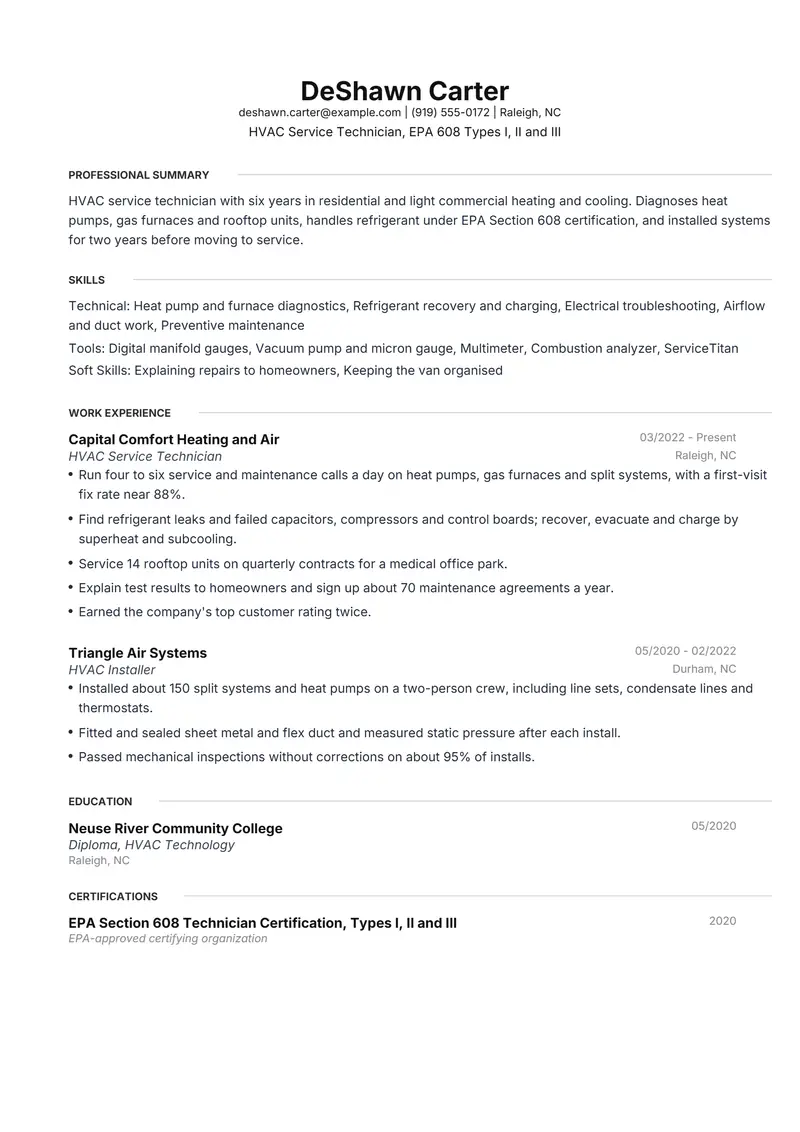
Meridian suits an HVAC technician because its labelled skill rows sit above the jobs, so your EPA 608 certification, the equipment you service and your diagnostic tools are read first. The fictional sample services heat pumps, furnaces and rooftop units with a high first-visit fix rate, after two years installing split systems; the page covers HVAC installers too.
Download the HVAC technician sample
DeShawn is a fictional HVAC service technician. Replace every detail with your own before you send it.
The files are made in your browser by Resumity's own exporters, from this sample. The builder opens it as your own resume: click any line to replace it. Free plan, no watermark.
Why Meridian suits an HVAC technician resume
Meridian prints Technical, Tools and Soft Skills rows under the summary and before work experience. HVAC service managers screen on refrigerant certification, equipment types and diagnostic gear, so having those at the top answers their first questions. The colourless page with grey rules prints cleanly on a shop printer.
Second choice: Leslie. Leslie puts experience before skills; a better fit once a long service record with one company is your main proof.
What goes in each section, in Meridian's order
Meridian prints its sections in a fixed order, the same in the PDF and the Word file. Here is that order for this sample, and what to put in each section.
- Professional Summary. Residential, commercial or both; service, install or both; years; and the equipment you know best. Name your EPA 608 certification types here, since certifications print near the end.
- Skills. Technical lists the work: heat pump and furnace diagnostics, refrigerant recovery and charging, electrical troubleshooting, airflow and duct work. Tools lists gauges, vacuum pump, meters and the dispatch app. Installers can add brazing, line sets and sheet metal.
- Work Experience. Service techs give calls per day, first-visit fix rate and the faults they find. Installers give systems installed, crew size and inspections passed. Commercial work (rooftop units, chillers, controls) deserves its own bullet.
- Education. The HVAC program or apprenticeship with the year. If the refrigerant exam was part of the program, say so in the detail line.
- Certifications. EPA Section 608 with the types you passed, state or local licenses with numbers, and any manufacturer training. List each with a year.
The sample resume as text
The same content as the files above, so you can copy a line or compare it with your own.
DeShawn Carter
HVAC Service Technician, EPA 608 Types I, II and III
Raleigh, NC | deshawn.carter@example.com | (919) 555-0172
HVAC service technician with six years in residential and light commercial heating and cooling. Diagnoses heat pumps, gas furnaces and rooftop units, handles refrigerant under EPA Section 608 certification, and installed systems for two years before moving to service.
Experience
HVAC Service Technician, Capital Comfort Heating and Air, Raleigh, NC (03/2022 to Present)
- Run four to six service and maintenance calls a day on heat pumps, gas furnaces and split systems, with a first-visit fix rate near 88%.
- Find refrigerant leaks and failed capacitors, compressors and control boards; recover, evacuate and charge by superheat and subcooling.
- Service 14 rooftop units on quarterly contracts for a medical office park.
- Explain test results to homeowners and sign up about 70 maintenance agreements a year.
- Earned the company's top customer rating twice.
HVAC Installer, Triangle Air Systems, Durham, NC (05/2020 to 02/2022)
- Installed about 150 split systems and heat pumps on a two-person crew, including line sets, condensate lines and thermostats.
- Fitted and sealed sheet metal and flex duct and measured static pressure after each install.
- Passed mechanical inspections without corrections on about 95% of installs.
Education
Diploma, HVAC Technology, Neuse River Community College (05/2020). EPA Section 608 exam taken during the program
Certifications
- EPA Section 608 Technician Certification, Types I, II and III, EPA-approved certifying organization (2020)
Skills
Heat pump and furnace diagnostics, Refrigerant recovery and charging, Electrical troubleshooting, Airflow and duct work, Preventive maintenance, Digital manifold gauges, Vacuum pump and micron gauge, Multimeter, Combustion analyzer, ServiceTitan, Explaining repairs to homeowners, Keeping the van organised
How to make the sample yours
State your 608 types
Type I for small appliances, Type II for high-pressure systems, Type III for low-pressure systems. List exactly the types you passed; a service manager checks them against the equipment you would work on.
Give a fix rate or callback rate
First-visit fix rate, callbacks within 30 days, maintenance visits per day. Pick the one your company tracked.
Name equipment and brands
Heat pumps, gas furnaces, mini-splits, rooftop units, boilers, and the brands you have serviced. Dealers for one brand look for its name.
For installers, show the full install
Line sets, condensate, electrical, thermostats, duct changes, start-up and static pressure checks. A complete install record is how installers move into service.
Show you can talk to homeowners
Explaining test results, offering repair or replace options, selling maintenance agreements honestly. Service companies value techs who customers trust.
Keywords to keep where they are true
Terms this kind of resume is usually searched for. Use the posting's exact wording, and only for work you have done.
- HVAC technician
- EPA 608 certification
- heat pumps
- gas furnaces
- air conditioning
- refrigerant recovery
- troubleshooting
- preventive maintenance
- rooftop units
- ductwork
- electrical diagnostics
- HVAC installation
- service calls
- customer service
Mistakes to avoid
- Writing "EPA certified" without the types.
- "Repaired HVAC systems" with no equipment, call volume or fix rate.
- Leaving out a state or local license when your area requires one.
- Listing brands you have only seen once on a ride-along.
How the sample PDF reads in text extractors
We exported this sample with Resumity's PDF exporter in Chrome on 2026-10-29 and read the file back with three open-source text extractors. This shows whether software that turns a PDF into text can recover it; it is not a test of any commercial applicant tracking system. How we test templates.
| Extractor | Name, email, phone | Headings | Bullets intact |
|---|---|---|---|
| pdf.js 4.10.38 | All found | 5 of 5 | 8 of 8 |
| pdftotext (Xpdf) 4.00 | All found | 5 of 5 | 8 of 8 |
| pypdf 6.13.0 | All found | 5 of 5 | 8 of 8 |
Frequently asked questions
Do HVAC technicians need EPA 608 certification?
Yes, for refrigerant work. EPA requires technicians who maintain, service, repair or dispose of equipment that could release refrigerants to be certified, with test sections for small appliances (Type I), high-pressure systems (Type II) and low-pressure systems (Type III). EPA does not issue cards itself, so list the types and the certifying organization.
Should I list a state HVAC license?
If you hold one, yes, with its number and year. BLS notes that some states and localities require HVAC technicians to be licensed, so check your area and put the license near the top if the posting asks for it.
How is an HVAC installer resume different from a service technician resume?
Installers show systems installed, crew role, line sets, duct changes, start-up and inspections. Service techs show diagnosis, fix rates and customer contact. If you are moving from install to service, add any troubleshooting you did at start-up.
Are manufacturer certifications worth listing?
Yes, if they match the brands the employer sells or services. BLS says manufacturer and industry certifications are mostly optional, though some employers prefer or require them.
What numbers make an HVAC resume stronger?
Calls per day, first-visit fix rate, callbacks, installs completed, maintenance agreements sold and inspection pass rate. Two or three are enough.
Will applicant tracking systems read this Meridian PDF?
The sample PDF read back with its contact details, all 5 section headings and all 8 bullets intact in three open-source text extractors (pdf.js, pdftotext and pypdf). Commercial systems such as Workday, Greenhouse or Taleo were not tested, and each employer configures its own.
Guides and templates for this resume
Sources, checked 29 October 2026
We opened every page below on that date. Pay, rules and requirements change, so check the source before you rely on a detail.
- U.S. Environmental Protection Agency: Section 608 Technician Certification (technicians who maintain, service, repair or dispose of equipment that could release refrigerants must be certified; test topics Core, Type 1 small appliances, Type 2 high-pressure, Type 3 low-pressure; EPA does not issue certification cards)
- U.S. Bureau of Labor Statistics: Heating, Air Conditioning, and Refrigeration Mechanics and Installers: How to Become One (some states and localities require licenses; EPA requires nearly all HVAC technicians to be certified in refrigerant handling; manufacturer or industry certifications are mostly optional, some employers prefer or require them)
More in resume templates by job title.