Resume template · Updated October 2026
Resume template for a career change
Short answer
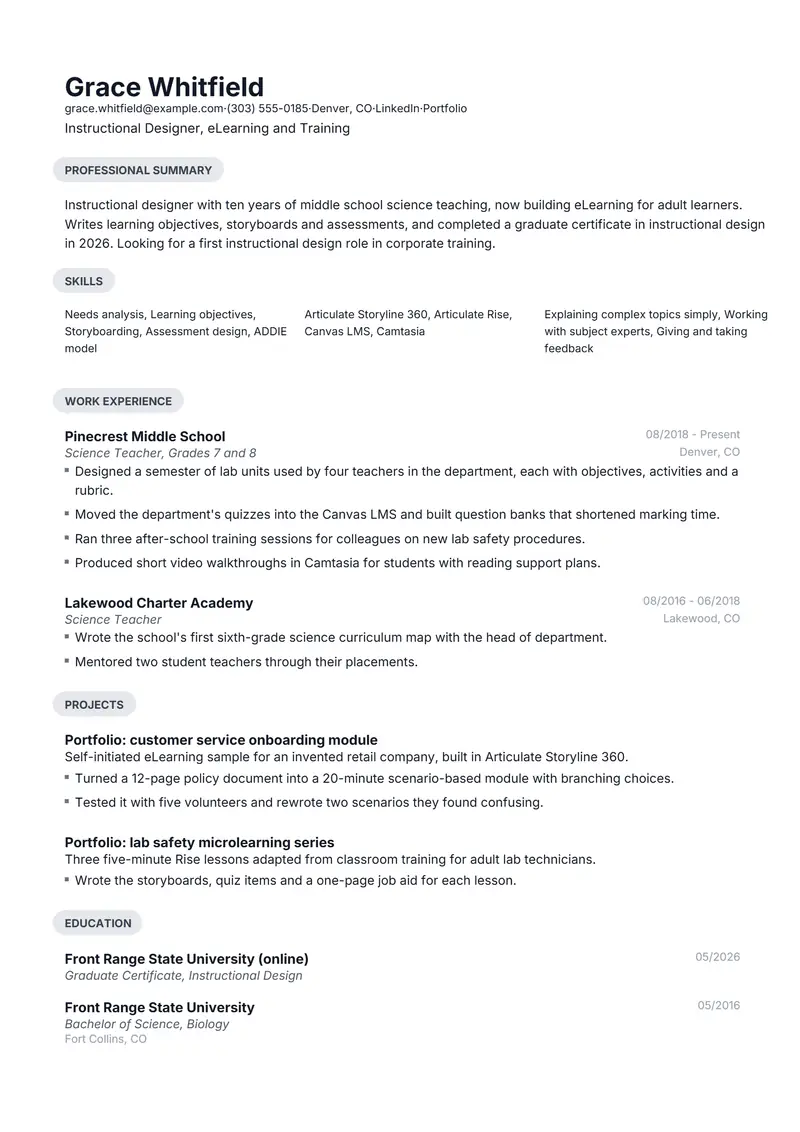
Daniel suits a career change because it prints your skills for the new field before the jobs from the old one, and its rounded heading pills give a designer's resume a softer look. The fictional sample is a middle school science teacher moving into instructional design, with transferable teaching work, a new certificate and two portfolio projects.
Download the career change sample
Grace is a fictional instructional designer. Replace every detail with your own before you send it.
The files are made in your browser by Resumity's own exporters, from this sample. The builder opens it as your own resume: click any line to replace it. Free plan, no watermark.
Why Daniel suits a career change resume
Daniel prints the skills section directly under the summary, ahead of work experience, so instructional design methods and authoring tools are read before the teaching jobs. Its rounded grey heading pills suit designers, the field this sample is moving into.
Second choice: Meridian. Meridian has the same skills-before-experience order with no colour and plain rules, a safer look if the field you are moving into is conservative, such as finance or government.
What goes in each section, in Daniel's order
Daniel prints its sections in a fixed order, the same in the PDF and the Word file. Here is that order for this sample, and what to put in each section.
- Professional Summary. Lead with the new job title, not the old one, then the years and kind of experience you bring across. One sentence on how you prepared (a course, portfolio work) shows the move is planned.
- Skills. Skills for the target role come first, then the transferable ones. Daniel shows them in a grid without group labels, so start with the methods and tools the new field's postings ask for.
- Work Experience. Keep your old job titles accurate, but choose bullets a hiring manager in the new field recognises: designing materials, training adults, working with data. Cut duties that only make sense inside the old field, such as lunch duty.
- Projects. Portfolio pieces fill the gap between your past roles and the new one. Name the tool you built each in and one thing you changed after testing it with real users.
- Education. Put the newest, most relevant qualification first, even if it is a short certificate. The original degree stays, but it no longer leads.
The sample resume as text
The same content as the files above, so you can copy a line or compare it with your own.
Grace Whitfield
Instructional Designer, eLearning and Training
Denver, CO | grace.whitfield@example.com | (303) 555-0185 | linkedin.com/in/sample-grace-whitfield | portfolio.example.com/grace-whitfield
Instructional designer with ten years of middle school science teaching, now building eLearning for adult learners. Writes learning objectives, storyboards and assessments, and completed a graduate certificate in instructional design in 2026. Looking for a first instructional design role in corporate training.
Experience
Science Teacher, Grades 7 and 8, Pinecrest Middle School, Denver, CO (08/2018 to Present)
- Designed a semester of lab units used by four teachers in the department, each with objectives, activities and a rubric.
- Moved the department's quizzes into the Canvas LMS and built question banks that shortened marking time.
- Ran three after-school training sessions for colleagues on new lab safety procedures.
- Produced short video walkthroughs in Camtasia for students with reading support plans.
Science Teacher, Lakewood Charter Academy, Lakewood, CO (08/2016 to 06/2018)
- Wrote the school's first sixth-grade science curriculum map with the head of department.
- Mentored two student teachers through their placements.
Projects
Portfolio: customer service onboarding module: Self-initiated eLearning sample for an invented retail company, built in Articulate Storyline 360.
- Turned a 12-page policy document into a 20-minute scenario-based module with branching choices.
- Tested it with five volunteers and rewrote two scenarios they found confusing.
Portfolio: lab safety microlearning series: Three five-minute Rise lessons adapted from classroom training for adult lab technicians.
- Wrote the storyboards, quiz items and a one-page job aid for each lesson.
Education
Graduate Certificate, Instructional Design, Front Range State University (online) (05/2026)
Bachelor of Science, Biology, Front Range State University (05/2016)
Skills
Needs analysis, Learning objectives, Storyboarding, Assessment design, ADDIE model, Articulate Storyline 360, Articulate Rise, Canvas LMS, Camtasia, Explaining complex topics simply, Working with subject experts, Giving and taking feedback
How to make the sample yours
Translate the old job into the new field's language
Teachers write "lesson plans"; instructional designers write "learning objectives" and "storyboards". Read five postings in the field you want and reuse their terms wherever they honestly describe what you did.
Cut bullets that only matter in the old career
Classroom management, parent conferences and test prep are real work but rarely transfer. Keep the two to four bullets your new manager would understand.
Build at least one portfolio project
A career changer's strongest evidence is work done in the new field. The sample uses two self-initiated modules; a volunteer project, a freelance job or a course assignment works too.
Keep the dates honest, however long the old job
Do not trim your teaching years to look newer to the field. Years of working with people and deadlines are an asset, and the summary frames them.
Rebuild the example around your own move
Moving from retail management into HR? Put recruiting and scheduling skills first and pick bullets about hiring, training and staff records. The structure stays the same.
Keywords to keep where they are true
Terms this kind of resume is usually searched for. Use the posting's exact wording, and only for work you have done.
- instructional design
- eLearning
- Articulate Storyline 360
- Articulate Rise
- storyboarding
- learning objectives
- needs analysis
- ADDIE
- LMS administration
- assessment design
- subject matter experts
- adult learning
- transferable skills
Mistakes to avoid
- Opening the summary with your old job title. Lead with the role you want and present the past as the experience behind it.
- Switching to a functional resume that hides dates and employers. A page with no timeline makes readers wonder what is missing.
- Giving a past job the new title. "Instructional Designer" is fine as your headline target; a job entry with that title is not, unless it was your real title.
- Listing every course from your certificate. Name the credential and show what you made with it.
How the sample PDF reads in text extractors
We exported this sample with Resumity's PDF exporter in Chrome on 2026-10-29 and read the file back with three open-source text extractors. This shows whether software that turns a PDF into text can recover it; it is not a test of any commercial applicant tracking system. How we test templates.
| Extractor | Name, email, phone | Headings | Bullets intact |
|---|---|---|---|
| pdf.js 4.10.38 | All found | 5 of 5 | 9 of 9 |
| pdftotext (Xpdf) 4.00 | All found | 5 of 5 | 9 of 9 |
| pypdf 6.13.0 | All found | 5 of 5 | 9 of 9 |
Frequently asked questions
How do I write a resume for a career change with no experience in the new field?
Name the new role in the summary, put relevant skills before your work history, rewrite old job bullets around transferable tasks, and add projects, courses or volunteer work done in the new field.
Should I use a functional resume for a career change?
Usually not. A skills-first layout with a full, dated work history, which is how this sample is built, shows the same strengths without hiding your timeline.
How far back should a career change resume go?
Ten to fifteen years is common. Older jobs from the old field can be dropped or cut to one line if they add nothing for the new role.
Do I need a cover letter when changing careers?
It helps more than usual, because it is the one place to explain why you are moving. Three short paragraphs work: the move, the evidence and the fit.
Will applicant tracking systems read this Daniel PDF?
The sample PDF read back with its contact details, all 5 section headings and all 9 bullets intact in three open-source text extractors (pdf.js, pdftotext and pypdf). Commercial systems such as Workday, Greenhouse or Taleo were not tested, and each employer configures its own.