Resume template · Updated October 2026
DevOps engineer resume template
Short answer
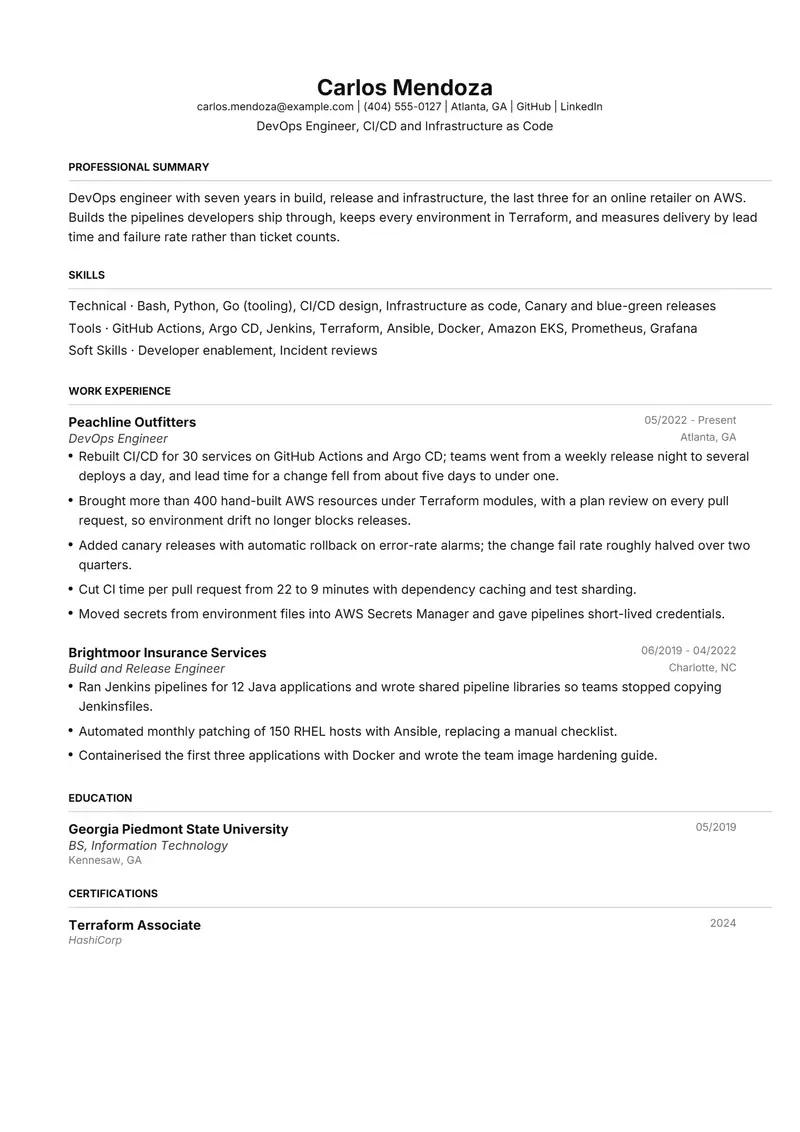
Pick FAANGPath for a DevOps engineer: its labelled skill rows sit above the jobs, so the CI system, Terraform, Kubernetes and the cloud are read before anything else. The fictional sample spent seven years in build, release and infrastructure, most recently for an online retailer, and reports delivery the way DevOps leads measure it: deploy frequency, lead time for a change, change fail rate and CI duration.
Download the DevOps engineer sample
Carlos is a fictional DevOps engineer. Replace every detail with your own before you send it.
The files are made in your browser by Resumity's own exporters, from this sample. The builder opens it as your own resume: click any line to replace it. Free plan, no watermark.
Why FAANGPath suits a DevOps engineer resume
FAANGPath prints a skills block of labelled rows, with a dot after each label, above the jobs. DevOps postings are mostly lists of named tools (a CI system, an IaC tool, an orchestrator, a cloud), so letting a screener tick those off before the first bullet saves a search, and the minimal black and grey page keeps attention on pipeline results.
Second choice: Leslie. Leslie prints experience ahead of skills under a centred blue header; choose it when your delivery results are stronger than your tool list, or the posting names few tools.
What goes in each section, in FAANGPath's order
FAANGPath prints its sections in a fixed order, the same in the PDF and the Word file. Here is that order for this sample, and what to put in each section.
- Professional Summary. State the parts of delivery you own (build, release, infrastructure, on-call) and the cloud you work in. If you track delivery metrics, say so here: it tells a hiring manager you think about developer outcomes, not only pipeline YAML.
- Skills. Put scripting languages and practices in Technical, then the named tools in Tools: CI system, IaC, orchestrator, cloud, monitoring. Leave out anything you met only in a tutorial; interviewers often ask you to sketch a pipeline in the first tool you list.
- Work Experience. Write before-and-after delivery numbers: how often teams deploy, how long a change takes to reach production, how often a deploy causes a failure, how long CI takes. DORA names these measures (change lead time, deployment frequency, change fail rate, failed deployment recovery time), and most DevOps leads know the vocabulary.
- Education. One line. People reach DevOps from operations, from development and from support, so a degree in an unrelated subject or none at all needs no explanation.
- Certifications. FAANGPath prints them near the end. A Terraform or Kubernetes certificate shows study, so pair each one with a bullet in experience where the same tool runs in production.
The sample resume as text
The same content as the files above, so you can copy a line or compare it with your own.
Carlos Mendoza
DevOps Engineer, CI/CD and Infrastructure as Code
Atlanta, GA | carlos.mendoza@example.com | (404) 555-0127 | github.com/sample-carlos-mendoza | linkedin.com/in/sample-carlos-mendoza
DevOps engineer with seven years in build, release and infrastructure, the last three for an online retailer on AWS. Builds the pipelines developers ship through, keeps every environment in Terraform, and measures delivery by lead time and failure rate rather than ticket counts.
Experience
DevOps Engineer, Peachline Outfitters, Atlanta, GA (05/2022 to Present)
- Rebuilt CI/CD for 30 services on GitHub Actions and Argo CD; teams went from a weekly release night to several deploys a day, and lead time for a change fell from about five days to under one.
- Brought more than 400 hand-built AWS resources under Terraform modules, with a plan review on every pull request, so environment drift no longer blocks releases.
- Added canary releases with automatic rollback on error-rate alarms; the change fail rate roughly halved over two quarters.
- Cut CI time per pull request from 22 to 9 minutes with dependency caching and test sharding.
- Moved secrets from environment files into AWS Secrets Manager and gave pipelines short-lived credentials.
Build and Release Engineer, Brightmoor Insurance Services, Charlotte, NC (06/2019 to 04/2022)
- Ran Jenkins pipelines for 12 Java applications and wrote shared pipeline libraries so teams stopped copying Jenkinsfiles.
- Automated monthly patching of 150 RHEL hosts with Ansible, replacing a manual checklist.
- Containerised the first three applications with Docker and wrote the team image hardening guide.
Education
BS, Information Technology, Georgia Piedmont State University (05/2019)
Certifications
- Terraform Associate, HashiCorp (2024)
Skills
Bash, Python, Go (tooling), CI/CD design, Infrastructure as code, Canary and blue-green releases, GitHub Actions, Argo CD, Jenkins, Terraform, Ansible, Docker, Amazon EKS, Prometheus, Grafana, Developer enablement, Incident reviews
How to make the sample yours
Swap the cloud and CI for your stack
Azure DevOps, GitLab CI, Google Cloud, Jenkins: change the summary, skills and bullets together. A page that says AWS in the summary and Azure in every bullet confuses the screen.
Measure delivery before and after
The sample moves from a weekly release night to several deploys a day and from about five days to under one for lead time. Pull your figures from the CI system or deployment history; if nobody measured, describe the change in words.
Show one safety change
Canary releases with automatic rollback, secrets moved out of files, signed images, policy checks on Terraform plans. Speed without safety reads as risk to a hiring manager.
Say how many teams depend on your work
"CI/CD for 30 services" sets the scale. Add the number of developers or teams if you know it, because DevOps work is judged by how many people it unblocks.
Drop the ticket-queue language
"Handled 300 infrastructure tickets" reads like support work. Rewrite it as what you automated so those tickets stopped coming.
Keywords to keep where they are true
Terms this kind of resume is usually searched for. Use the posting's exact wording, and only for work you have done.
- CI/CD pipelines
- infrastructure as code
- Terraform
- Kubernetes
- Docker
- GitHub Actions
- Argo CD
- GitOps
- AWS
- Ansible
- canary deployments
- DORA metrics
- deployment frequency
- change lead time
- observability
Mistakes to avoid
- A skills row with every cloud-native logo you recognise. List what you have run.
- Pipeline bullets with no outcome. "Created Jenkins jobs" says nothing about speed or safety.
- Writing as if you were the whole DevOps function. Name the developers and teams you supported and what was yours.
- Leaving security out. Secrets handling, image scanning and least-privilege pipeline credentials are part of most DevOps roles.
How the sample PDF reads in text extractors
We exported this sample with Resumity's PDF exporter in Chrome on 2026-10-29 and read the file back with three open-source text extractors. This shows whether software that turns a PDF into text can recover it; it is not a test of any commercial applicant tracking system. How we test templates.
| Extractor | Name, email, phone | Headings | Bullets intact |
|---|---|---|---|
| pdf.js 4.10.38 | All found | 5 of 5 | 8 of 8 |
| pdftotext (Xpdf) 4.00 | All found | 5 of 5 | 8 of 8 |
| pypdf 6.13.0 | All found | 5 of 5 | 8 of 8 |
Frequently asked questions
How is a DevOps resume different from an SRE resume?
A DevOps resume leads with delivery: pipelines, environments and how fast and safely code reaches production. An SRE resume leads with reliability targets, incidents and on-call. Many people do both; let the headline say which one the posting wants.
Which delivery metrics belong on a DevOps resume?
The ones you actually tracked. DORA lists change lead time, deployment frequency, change fail rate, failed deployment recovery time and deployment rework rate; one or two before-and-after pairs are plenty.
Are DevOps certifications worth listing?
List the ones you hold. HashiCorp describes Terraform Associate as a one-hour multiple-choice exam for people starting out with Terraform, so it supports a production bullet rather than replacing one.
How do I move into DevOps from system administration?
Lead with the automation you already do: Ansible, scripts, CI jobs, containers. The older job in the sample (patching with Ansible, the first containers) shows that bridge; keep a bullet like it even after your title changes.
Should I link a GitHub profile with my Terraform modules?
Yes, if the code is yours to share and has a README. Strip anything that came from an employer, including account IDs, internal hostnames and state files.
Will applicant tracking systems read this FAANGPath PDF?
The sample PDF read back with its contact details, all 5 section headings and all 8 bullets intact in three open-source text extractors (pdf.js, pdftotext and pypdf). Commercial systems such as Workday, Greenhouse or Taleo were not tested, and each employer configures its own.
Guides and templates for this resume
Sources, checked 29 October 2026
We opened every page below on that date. Pay, rules and requirements change, so check the source before you rely on a detail.
- DORA: DORA's software delivery performance metrics (five measures: change lead time, deployment frequency, failed deployment recovery time, change fail rate, deployment rework rate)
- HashiCorp: Infrastructure automation certifications (Terraform Associate: a one-hour multiple-choice exam on foundational Terraform skills)
More in resume templates by job title.