Resume template · Updated October 2026
Research scientist resume template
Short answer
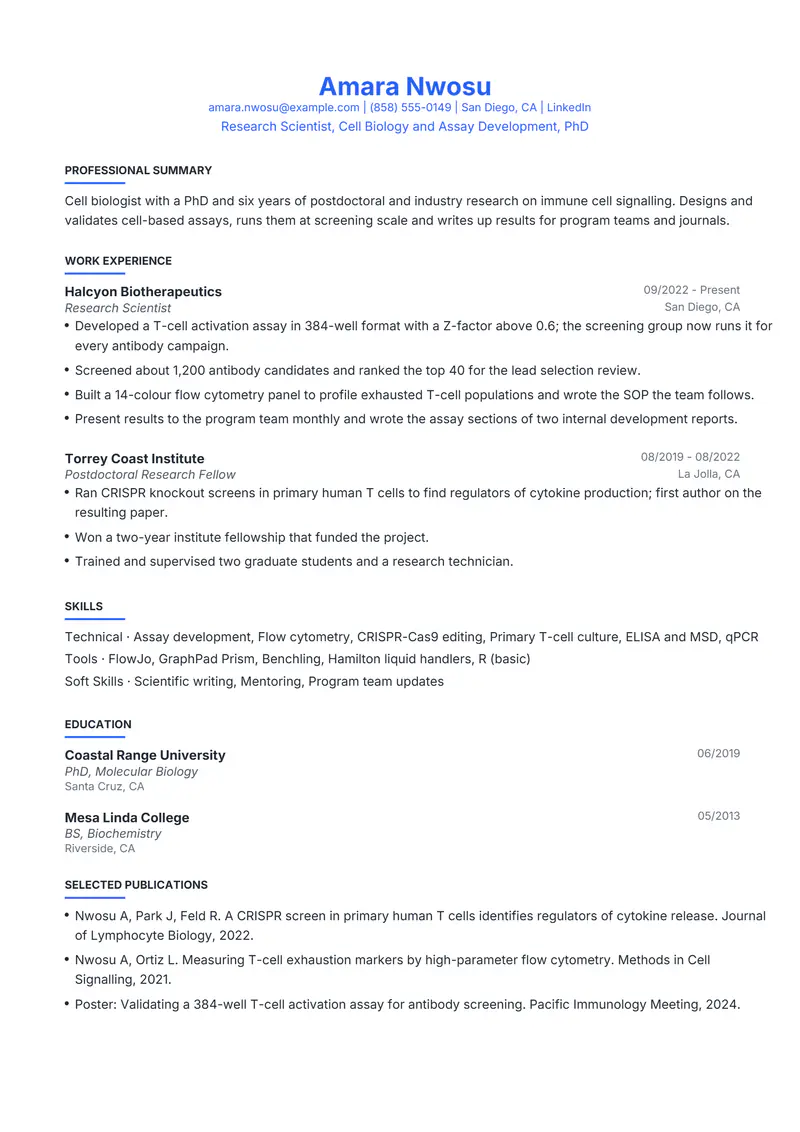
Choose Leslie for an industry research scientist resume. It keeps a short summary for your field and PhD, then prints experience before skills, so assays and results are read before the technique list. The fictional sample is a cell biologist at a biotech company after a postdoc: a screening assay the company now runs routinely, an antibody campaign, a 14-colour flow panel and a short list of selected publications.
Download the research scientist sample
Amara is a fictional research scientist. Replace every detail with your own before you send it.
The files are made in your browser by Resumity's own exporters, from this sample. The builder opens it as your own resume: click any line to replace it. Free plan, no watermark.
Why Leslie suits a research scientist resume
Leslie prints the summary, then work experience, then skills. An industry hiring manager reading a scientist's resume wants to see what you developed and what it enabled before scanning techniques, and the summary gives room to state degree, field and model systems in two lines. Its centred blue header is the only colour on the page.
Second choice: Henrietta. Henrietta moves education up to sit directly after experience; choose it for early-career scientist posts that screen on the PhD first.
What goes in each section, in Leslie's order
Leslie prints its sections in a fixed order, the same in the PDF and the Word file. Here is that order for this sample, and what to put in each section.
- Professional Summary. Degree, field and the biology you work on, then what you do with it: "designs and validates cell-based assays and runs them at screening scale". Industry readers need to place you on a program team, so name the stage of research you fit.
- Work Experience. Treat the postdoc as a job, with bullets. For each role, write what you built (an assay, a panel, a model system), its scale (well format, number of candidates screened) and who used the result. Mention first-author papers inside the relevant bullet.
- Skills. Technical: the techniques you could run tomorrow unsupervised (flow cytometry, CRISPR editing, primary cell culture, ELISA). Tools: analysis software, the electronic lab notebook and automation platforms. Leave out methods you only observed.
- Education. PhD first with field, school and year; a one-line thesis title is fine if it relates to the role. The bachelor's degree goes below it.
- Selected publications. The sample titles this list "Selected publications" and keeps three entries. Industry resumes are shorter than academic CVs, so pick the papers closest to the role and put your name in the citation as it appears in the journal.
The sample resume as text
The same content as the files above, so you can copy a line or compare it with your own.
Amara Nwosu
Research Scientist, Cell Biology and Assay Development, PhD
San Diego, CA | amara.nwosu@example.com | (858) 555-0149 | linkedin.com/in/sample-amara-nwosu
Cell biologist with a PhD and six years of postdoctoral and industry research on immune cell signalling. Designs and validates cell-based assays, runs them at screening scale and writes up results for program teams and journals.
Experience
Research Scientist, Halcyon Biotherapeutics, San Diego, CA (09/2022 to Present)
- Developed a T-cell activation assay in 384-well format with a Z-factor above 0.6; the screening group now runs it for every antibody campaign.
- Screened about 1,200 antibody candidates and ranked the top 40 for the lead selection review.
- Built a 14-colour flow cytometry panel to profile exhausted T-cell populations and wrote the SOP the team follows.
- Present results to the program team monthly and wrote the assay sections of two internal development reports.
Postdoctoral Research Fellow, Torrey Coast Institute, La Jolla, CA (08/2019 to 08/2022)
- Ran CRISPR knockout screens in primary human T cells to find regulators of cytokine production; first author on the resulting paper.
- Won a two-year institute fellowship that funded the project.
- Trained and supervised two graduate students and a research technician.
Selected publications
- Nwosu A, Park J, Feld R. A CRISPR screen in primary human T cells identifies regulators of cytokine release. Journal of Lymphocyte Biology, 2022.
- Nwosu A, Ortiz L. Measuring T-cell exhaustion markers by high-parameter flow cytometry. Methods in Cell Signalling, 2021.
- Poster: Validating a 384-well T-cell activation assay for antibody screening. Pacific Immunology Meeting, 2024.
Education
PhD, Molecular Biology, Coastal Range University (06/2019)
BS, Biochemistry, Mesa Linda College (05/2013)
Skills
Assay development, Flow cytometry, CRISPR-Cas9 editing, Primary T-cell culture, ELISA and MSD, qPCR, FlowJo, GraphPad Prism, Benchling, Hamilton liquid handlers, R (basic), Scientific writing, Mentoring, Program team updates
How to make the sample yours
Cut the academic CV down to an industry resume
Two pages at most. Teaching, every poster and the full publication list belong in a CV; here keep the work that matches the posting and a handful of selected papers.
Lead with the techniques the posting names
If the job asks for high-throughput screening and flow cytometry, those should appear in your first bullets, not only in the skills rows.
Translate results into program terms
Industry teams talk about campaigns, lead selection and development reports. "Ranked the top 40 of 1,200 candidates for lead selection" reads better to them than a description of the biology alone.
Add your ORCID iD to the header links
An ORCID iD is a free, persistent identifier that links to your publication record, so a reader can check your papers in one click.
Keep confidential work vague
Use target classes ("an immuno-oncology antibody program") rather than compound names or unpublished data from your current employer.
Keywords to keep where they are true
Terms this kind of resume is usually searched for. Use the posting's exact wording, and only for work you have done.
- research scientist
- assay development
- cell-based assays
- flow cytometry
- CRISPR-Cas9
- high-throughput screening
- primary cell culture
- ELISA
- qPCR
- GraphPad Prism
- standard operating procedures
- scientific writing
- electronic lab notebook
- cross-functional teams
Mistakes to avoid
- Pasting the full academic CV with every poster, talk and course taught.
- Bullets that describe the biology of the project but not what you did in it.
- Naming compounds, targets or data your employer has not made public.
- A techniques list that includes methods you watched a colleague run.
How the sample PDF reads in text extractors
We exported this sample with Resumity's PDF exporter in Chrome on 2026-10-29 and read the file back with three open-source text extractors. This shows whether software that turns a PDF into text can recover it; it is not a test of any commercial applicant tracking system. How we test templates.
| Extractor | Name, email, phone | Headings | Bullets intact |
|---|---|---|---|
| pdf.js 4.10.38 | All found | 5 of 5 | 7 of 7 |
| pdftotext (Xpdf) 4.00 | All found | 5 of 5 | 7 of 7 |
| pypdf 6.13.0 | All found | 5 of 5 | 7 of 7 |
Frequently asked questions
Should I send a resume or a CV for industry research scientist jobs?
Usually a resume of one or two pages, unless the posting asks for a CV. Companies want to see what you can do for their program; universities and institutes want the full academic record.
How many publications should I list?
Three to five that relate to the role, with your name as it appears in the journal. Add a line such as "Full list on ORCID" with your iD in the header if you have more.
Does a postdoc count as work experience?
Yes. List it under work experience with dates and bullets like any job. It is paid research, often with supervision and grant writing that industry values.
Where does the PhD go if the template prints education low on the page?
Put "PhD" in your headline and summary, as the sample does. A reader then knows your degree from the top of the page, whatever order the sections follow.
How do I show I can work in an industry team?
Mention program teams, timelines and handoffs: an assay another group now runs, reports written for decision meetings, SOPs others follow. Those show your work outlasts your bench.
Will applicant tracking systems read this Leslie PDF?
The sample PDF read back with its contact details, all 5 section headings and all 7 bullets intact in three open-source text extractors (pdf.js, pdftotext and pypdf). Commercial systems such as Workday, Greenhouse or Taleo were not tested, and each employer configures its own.
Guides and templates for this resume
Sources, checked 29 October 2026
We opened every page below on that date. Pay, rules and requirements change, so check the source before you rely on a detail.
- ORCID: What is ORCID? (ORCID provides a unique, persistent identifier free of charge to researchers, connected to a record of their work and affiliations)
More in resume templates by job title.