Resume template · Updated October 2026
Statistician resume template
Short answer
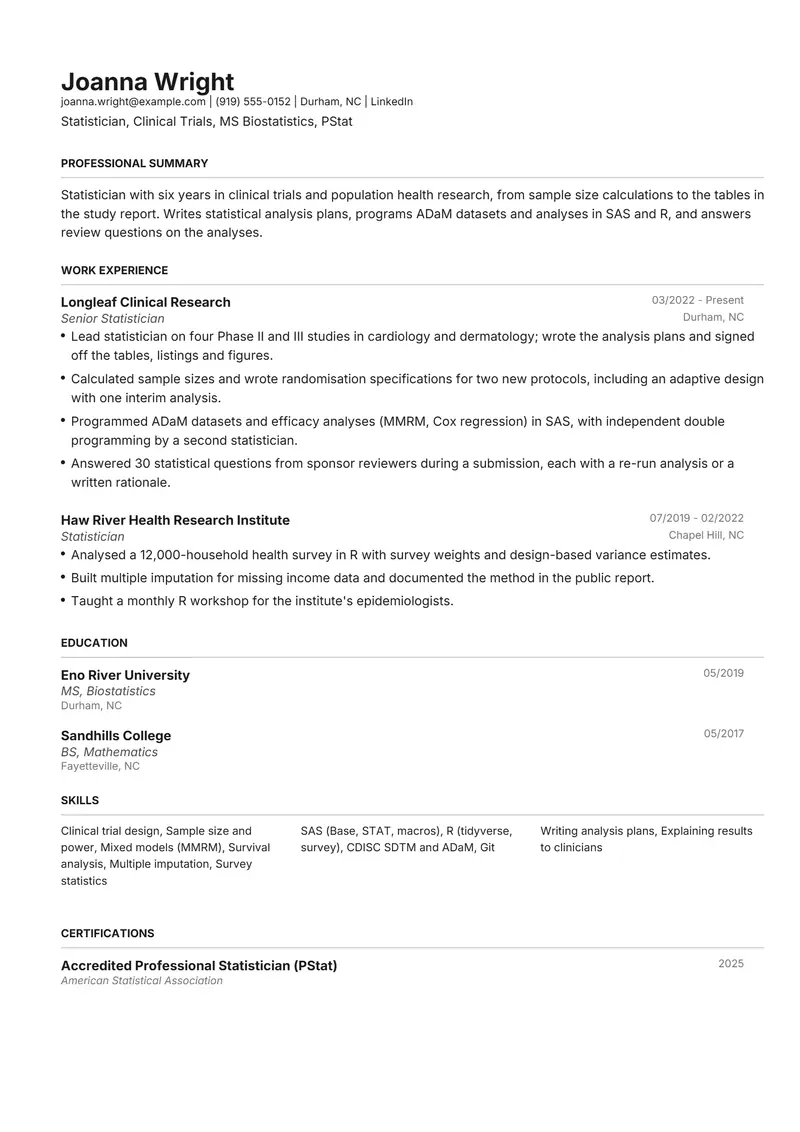
Henrietta is a sound choice for statisticians: a conventional page that prints education straight after experience, where an MS or PhD in statistics belongs. The fictional sample is a clinical trials statistician at a contract research organisation who writes analysis plans, sizes studies, programs ADaM datasets in SAS and answers sponsor review questions, with earlier survey work in R and an ASA accreditation.
Download the statistician sample
Joanna is a fictional statistician. Replace every detail with your own before you send it.
The files are made in your browser by Resumity's own exporters, from this sample. The builder opens it as your own resume: click any line to replace it. Free plan, no watermark.
Why Henrietta suits a statistician resume
Henrietta prints education directly after work experience, and a graduate degree in statistics or biostatistics is often a stated requirement for these jobs. It is also the plain, conventional business page that pharmaceutical sponsors, contract research organisations and government agencies are used to, with a three-column grid for short skills like SAS, R and MMRM.
Second choice: Leslie. Leslie keeps skill labels, so methods and software sit in separate rows, and adds a blue header; education moves below skills.
What goes in each section, in Henrietta's order
Henrietta prints its sections in a fixed order, the same in the PDF and the Word file. Here is that order for this sample, and what to put in each section.
- Professional Summary. Field and setting first ("clinical trials at a contract research organisation", "household surveys at a public health institute"), then the span of work you cover, from design and sample size to analysis and reporting.
- Work Experience. Name the study type, phase or survey, then your role in it: lead statistician, analysis plan author, programmer, reviewer. Name methods where they did the work (mixed models, survival analysis, multiple imputation, survey weights) and say how your outputs are checked.
- Education. Henrietta prints this right after the jobs. Give degree, field, school and year; a thesis or capstone title is worth one line if it matches the area you are applying to.
- Skills. No labels print in the grid, so open with methods (trial design, sample size, MMRM, survival analysis), then software and standards (SAS, R, CDISC ADaM and SDTM), then the working skills such as writing analysis plans.
- Certifications. The ASA's PStat accreditation is portfolio-based and requires an advanced degree and five years of documented experience; GStat is the entry-level version. Henrietta prints this last, so mention PStat in the headline if it matters for the role.
The sample resume as text
The same content as the files above, so you can copy a line or compare it with your own.
Joanna Wright
Statistician, Clinical Trials, MS Biostatistics, PStat
Durham, NC | joanna.wright@example.com | (919) 555-0152 | linkedin.com/in/sample-joanna-wright
Statistician with six years in clinical trials and population health research, from sample size calculations to the tables in the study report. Writes statistical analysis plans, programs ADaM datasets and analyses in SAS and R, and answers review questions on the analyses.
Experience
Senior Statistician, Longleaf Clinical Research, Durham, NC (03/2022 to Present)
- Lead statistician on four Phase II and III studies in cardiology and dermatology; wrote the analysis plans and signed off the tables, listings and figures.
- Calculated sample sizes and wrote randomisation specifications for two new protocols, including an adaptive design with one interim analysis.
- Programmed ADaM datasets and efficacy analyses (MMRM, Cox regression) in SAS, with independent double programming by a second statistician.
- Answered 30 statistical questions from sponsor reviewers during a submission, each with a re-run analysis or a written rationale.
Statistician, Haw River Health Research Institute, Chapel Hill, NC (07/2019 to 02/2022)
- Analysed a 12,000-household health survey in R with survey weights and design-based variance estimates.
- Built multiple imputation for missing income data and documented the method in the public report.
- Taught a monthly R workshop for the institute's epidemiologists.
Education
MS, Biostatistics, Eno River University (05/2019)
BS, Mathematics, Sandhills College (05/2017)
Certifications
- Accredited Professional Statistician (PStat), American Statistical Association (2025)
Skills
Clinical trial design, Sample size and power, Mixed models (MMRM), Survival analysis, Multiple imputation, Survey statistics, SAS (Base, STAT, macros), R (tidyverse, survey), CDISC SDTM and ADaM, Git, Writing analysis plans, Explaining results to clinicians
How to make the sample yours
Name the phase, area and design
Phase II dermatology, Phase III cardiology, an adaptive design with an interim analysis: each tells a sponsor or CRO which studies you could lead tomorrow. Replace the sample's studies with yours.
Separate design work from programming
Writing the analysis plan and calculating sample size are different skills from programming tables. Give each its own bullet so a reader sees your full range.
Show how outputs are validated
Independent double programming, code review or QC checklists. Regulated work depends on it, and saying so tells the reader you work to that standard.
Adapt the sample for government or survey roles
Swap trial terms for sampling design, weighting, variance estimation and disclosure control, and name the survey and its size as the earlier job does.
Keep software and standards exact
SAS (Base, STAT, macros), R packages you use, CDISC SDTM and ADaM. Pharma screens look for these by name, and the versions of standards change over time.
Keywords to keep where they are true
Terms this kind of resume is usually searched for. Use the posting's exact wording, and only for work you have done.
- statistician
- biostatistics
- statistical analysis plan
- sample size calculation
- clinical trials
- SAS
- R
- CDISC ADaM
- SDTM
- mixed models
- survival analysis
- multiple imputation
- tables, listings and figures
- randomization
- survey weighting
Mistakes to avoid
- A list of every test from your degree (t-test, chi-square, ANOVA). Name the methods you used on real studies.
- Claims that your analysis "proved" a treatment works. Statisticians report evidence; write it that way.
- Sponsor names, compound codes or unpublished results from confidential studies.
- Listing SAS and R without saying what you produced with them.
How the sample PDF reads in text extractors
We exported this sample with Resumity's PDF exporter in Chrome on 2026-10-29 and read the file back with three open-source text extractors. This shows whether software that turns a PDF into text can recover it; it is not a test of any commercial applicant tracking system. How we test templates.
| Extractor | Name, email, phone | Headings | Bullets intact |
|---|---|---|---|
| pdf.js 4.10.38 | All found | 5 of 5 | 7 of 7 |
| pdftotext (Xpdf) 4.00 | All found | 5 of 5 | 7 of 7 |
| pypdf 6.13.0 | All found | 5 of 5 | 7 of 7 |
Frequently asked questions
How is a statistician resume different from a data scientist resume?
It leans on design and inference: analysis plans, sample size, the assumptions behind a model, documented methods. Data science resumes lean on prediction and products. If you are applying across both, adjust the summary and the order of bullets.
Should I list PStat or GStat accreditation?
Yes, if you hold it. The ASA reviews degrees, experience and samples of work for PStat, so it tells a reader your practice has been checked. GStat signals the education without the years of experience yet.
Do I need CDISC experience for pharma statistician roles?
For most sponsor and CRO roles it helps a great deal: CDISC states that ADaM is a required standard for data submitted to the FDA in the US and PMDA in Japan. Name SDTM and ADaM if you have worked with them.
How do I describe confidential trials?
Use phase, therapeutic area, design and your role, and leave out sponsor and compound names. "Phase III cardiology study, lead statistician" is enough for a reader to judge your experience.
How long should a statistician resume be?
One page with up to about eight years of experience. Senior statisticians with many studies or publications can use two, keeping the study list selective.
Will applicant tracking systems read this Henrietta PDF?
The sample PDF read back with its contact details, all 5 section headings and all 7 bullets intact in three open-source text extractors (pdf.js, pdftotext and pypdf). Commercial systems such as Workday, Greenhouse or Taleo were not tested, and each employer configures its own.
Guides and templates for this resume
Sources, checked 29 October 2026
We opened every page below on that date. Pay, rules and requirements change, so check the source before you rely on a detail.
- American Statistical Association: Accreditation (PStat and GStat) (PStat is portfolio-based: advanced degree in statistics or a related field, at least five years of documented experience, samples of work, ASA membership; GStat is the entry-level accreditation)
- CDISC: Analysis Data Model (ADaM) (ADaM is one of the required standards for data submission to FDA (U.S.) and PMDA (Japan); analysis data traces back to SDTM)
More in resume templates by job title.