Resume template · Updated October 2026
Artificial intelligence resume template
Short answer
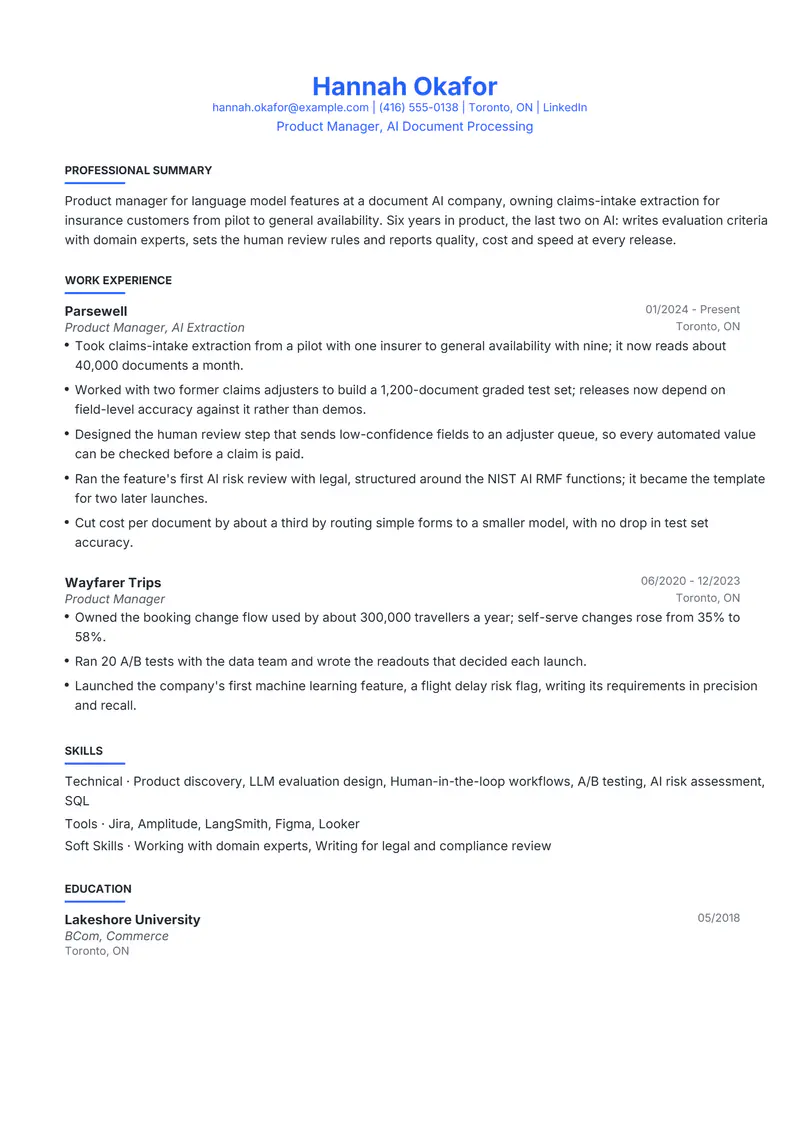
Leslie fits most people joining AI companies in non-research roles. It prints experience before skills, and in AI the shipped feature, how it is evaluated and who uses it matter more than a list of model names. The fictional sample is a product manager at a Toronto company selling document AI to insurers, with a graded test set, a human review step, a structured risk review and adoption figures.
Download the artificial intelligence sample
Hannah is a fictional product manager. Replace every detail with your own before you send it.
The files are made in your browser by Resumity's own exporters, from this sample. The builder opens it as your own resume: click any line to replace it. Free plan, no watermark.
Why Leslie suits an artificial intelligence resume
Leslie puts work experience straight after the summary and ahead of the skills rows. Lists of AI tools and methods look nearly identical from one applicant to the next, while a launched feature with an evaluation method and real users does not, so the order plays to the strongest evidence. The centred blue header is its only colour.
Second choice: Daniel. Daniel, suggested for product managers and designers, prints the skills grid before the jobs and sets headings in soft grey pills.
What goes in each section, in Leslie's order
Leslie prints its sections in a fixed order, the same in the PDF and the Word file. Here is that order for this sample, and what to put in each section.
- Professional Summary. Say what the model does in your product and who relies on it ("extracts claim details for insurance adjusters"), then how far you have taken it: prototype, launch, day-to-day operation. The AI industry is crowded with demos; a summary that mentions general availability and a quality measure shows you went further.
- Work Experience. For every AI feature, give three things: how quality is measured (test set size, who graded it, the metric), what happens when the model is wrong (review queue, fallback, override), and volume or adoption. Mention cost or latency once. Keep pre-AI jobs, written to show the product, data or domain skills that carried over.
- Skills. Leslie prints labelled rows after the jobs. Put methods in Technical (evaluation design, human review workflows, risk assessment, experimentation) and the products you use daily in Tools. Name approaches rather than model versions, which go out of date within months.
- Education. Degree, school and year. AI companies hiring for product, operations, sales or policy look at shipped work first; a research degree matters mainly for research and modelling roles.
The sample resume as text
The same content as the files above, so you can copy a line or compare it with your own.
Hannah Okafor
Product Manager, AI Document Processing
Toronto, ON | hannah.okafor@example.com | (416) 555-0138 | linkedin.com/in/sample-hannah-okafor
Product manager for language model features at a document AI company, owning claims-intake extraction for insurance customers from pilot to general availability. Six years in product, the last two on AI: writes evaluation criteria with domain experts, sets the human review rules and reports quality, cost and speed at every release.
Experience
Product Manager, AI Extraction, Parsewell, Toronto, ON (01/2024 to Present)
- Took claims-intake extraction from a pilot with one insurer to general availability with nine; it now reads about 40,000 documents a month.
- Worked with two former claims adjusters to build a 1,200-document graded test set; releases now depend on field-level accuracy against it rather than demos.
- Designed the human review step that sends low-confidence fields to an adjuster queue, so every automated value can be checked before a claim is paid.
- Ran the feature's first AI risk review with legal, structured around the NIST AI RMF functions; it became the template for two later launches.
- Cut cost per document by about a third by routing simple forms to a smaller model, with no drop in test set accuracy.
Product Manager, Wayfarer Trips, Toronto, ON (06/2020 to 12/2023)
- Owned the booking change flow used by about 300,000 travellers a year; self-serve changes rose from 35% to 58%.
- Ran 20 A/B tests with the data team and wrote the readouts that decided each launch.
- Launched the company's first machine learning feature, a flight delay risk flag, writing its requirements in precision and recall.
Education
BCom, Commerce, Lakeshore University (05/2018)
Skills
Product discovery, LLM evaluation design, Human-in-the-loop workflows, A/B testing, AI risk assessment, SQL, Jira, Amplitude, LangSmith, Figma, Looker, Working with domain experts, Writing for legal and compliance review
How to make the sample yours
Describe your evaluation in one line
Test set size, who labelled it, what is scored and the bar for release. If you only have a demo, build a small graded set before applying; interviewers at AI companies ask about evaluation more than anything else.
Name governance work you actually did
NIST's AI Risk Management Framework is voluntary and built around four functions: Govern, Map, Measure and Manage. If your employer sells into the EU, the AI Act sorts systems by risk level, and AI used in recruitment is among the high-risk uses. Mention either only where you contributed.
Bring your old domain with you
Former adjusters, nurses, lawyers and teachers are hired by AI companies to define what a correct answer looks like. If the company sells into your old field, put that field in the headline.
Separate calling a model from building one
Write "integrated a hosted model", "fine-tuned" or "trained" accurately. Product, sales and operations roles rarely need training experience, but they do need you to describe the system honestly.
Adjust the sample for your role
Solutions engineers lead with customer deployments and integrations; data specialists and AI trainers with labelling volume, guideline writing and agreement between reviewers; policy staff with assessments and documentation. Keep the evaluation and oversight vocabulary in every version.
Keywords to keep where they are true
Terms this kind of resume is usually searched for. Use the posting's exact wording, and only for work you have done.
- artificial intelligence
- large language models
- machine learning
- model evaluation
- human-in-the-loop
- responsible AI
- AI governance
- NIST AI RMF
- EU AI Act
- precision and recall
- data labelling
- prompt design
- A/B testing
- product discovery
Mistakes to avoid
- "Passionate about AI" in the summary with no feature, use or result behind it.
- Accuracy figures with no description of the test set or who graded it.
- Claiming a product complies with the EU AI Act or another rule on your own authority. Say you contributed to an assessment alongside legal counsel.
- Deleting years of non-AI work. The product, data or domain judgement from them is what an AI company is hiring.
How the sample PDF reads in text extractors
We exported this sample with Resumity's PDF exporter in Chrome on 2026-10-29 and read the file back with three open-source text extractors. This shows whether software that turns a PDF into text can recover it; it is not a test of any commercial applicant tracking system. How we test templates.
| Extractor | Name, email, phone | Headings | Bullets intact |
|---|---|---|---|
| pdf.js 4.10.38 | All found | 4 of 4 | 8 of 8 |
| pdftotext (Xpdf) 4.00 | All found | 4 of 4 | 8 of 8 |
| pypdf 6.13.0 | All found | 4 of 4 | 8 of 8 |
Frequently asked questions
Can I work at an AI company without a machine learning background?
Yes. Product, design, sales, solutions engineering, operations, data labelling and policy roles all exist at AI companies. Show that you understand how the system is evaluated and where it fails, and bring the domain knowledge from your earlier work.
Which AI regulations are worth knowing for a resume?
It depends where your employer sells. The EU AI Act, Regulation (EU) 2024/1689, is the main binding law; the European Commission says its rules for the high-risk uses in Annex III, which include AI for recruitment, apply from 2 December 2027. In the US, NIST publishes the voluntary AI Risk Management Framework.
Should I list AI tools like chat assistants on my resume?
Only as part of a result: "drafted support replies with a language model and cut handling time" says something, a tool name alone does not. For roles at AI companies, describe systems you built or ran rather than assistants you used.
How do I show AI results if my company will not share numbers?
Give relative changes (cost per document down a third, review queue halved) and describe the method in detail. The evaluation design is itself evidence, even without the figures.
Is a short AI course worth adding?
It helps most when you are moving in from another field and have nothing else to show. Pair it with something you built or evaluated; alone it carries little weight with AI employers.
Will applicant tracking systems read this Leslie PDF?
The sample PDF read back with its contact details, all 4 section headings and all 8 bullets intact in three open-source text extractors (pdf.js, pdftotext and pypdf). Commercial systems such as Workday, Greenhouse or Taleo were not tested, and each employer configures its own.
Guides and templates for this resume
Sources, checked 29 October 2026
We opened every page below on that date. Pay, rules and requirements change, so check the source before you rely on a detail.
- European Commission: AI Act: regulatory framework for AI (Regulation (EU) 2024/1689; four risk levels; recruitment tools listed as high-risk; Annex III high-risk obligations apply from 2 December 2027 after the AI Omnibus)
- NIST: AI Risk Management Framework (AI RMF 1.0 released 26 January 2023 for voluntary use; functions Govern, Map, Measure, Manage)
More in resume templates by industry.