Resume template · Updated October 2026
Biotechnology resume template
Short answer
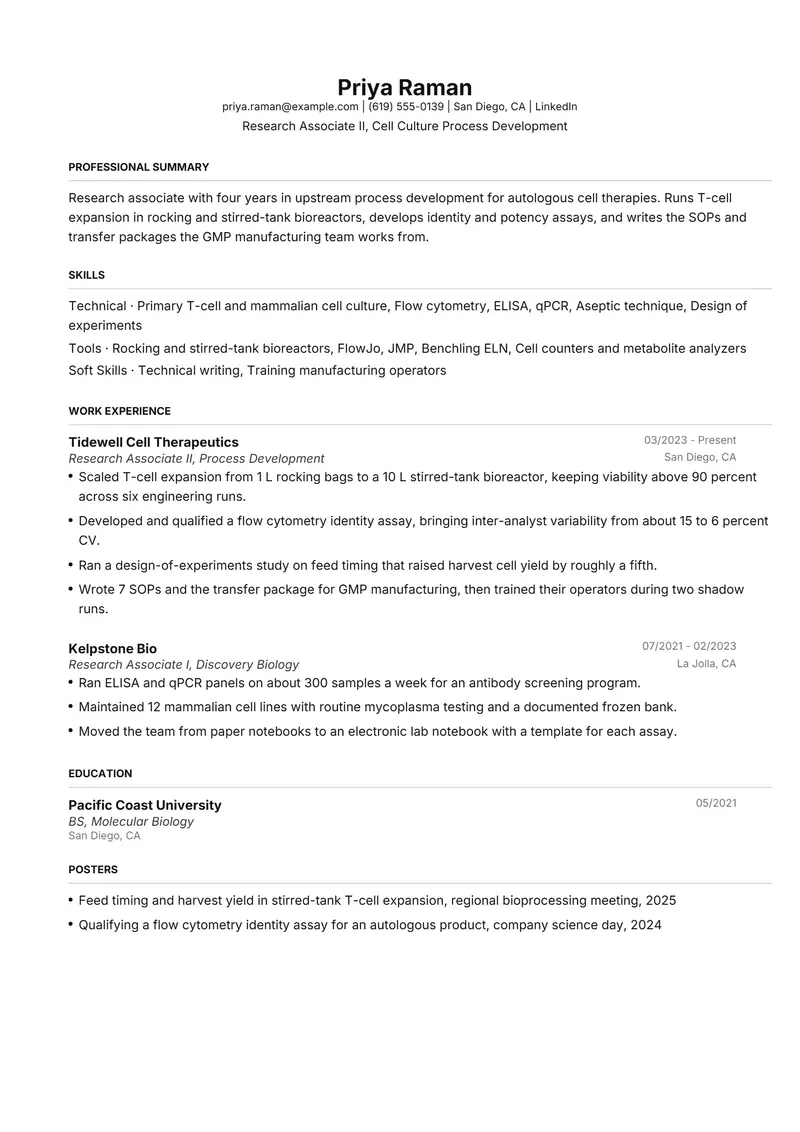
FAANGPath works for most biotech scientists and research associates: its labelled skill rows come before the jobs, so cell culture, flow cytometry, qPCR and your instruments are read first. The fictional sample is a research associate in cell therapy process development, with a bioreactor scale-up, a qualified identity assay, a design-of-experiments study and a tech transfer to manufacturing, after an earlier discovery biology role.
Download the biotechnology sample
Priya is a fictional research associate II. Replace every detail with your own before you send it.
The files are made in your browser by Resumity's own exporters, from this sample. The builder opens it as your own resume: click any line to replace it. Free plan, no watermark.
Why FAANGPath suits a biotechnology resume
FAANGPath is meant for technical candidates who want their tools read before their jobs, and biotech postings are built on techniques: the assays, cell types and instruments a hiring scientist needs on day one. Labelled Technical and Tools rows above the experience make that match quick, and the black and grey page prints cleanly for a panel.
Second choice: Meridian. Meridian prints the same sections in the same order; only the heading rules and skill labels look different, so choose whichever you prefer.
What goes in each section, in FAANGPath's order
FAANGPath prints its sections in a fixed order, the same in the PDF and the Word file. Here is that order for this sample, and what to put in each section.
- Professional Summary. Open with the stage you work in (discovery, process or analytical development, QC, manufacturing) and the modality (antibodies, cell or gene therapy, enzymes, diagnostics). Then the documentation standard you work to, research grade, GLP or GMP, because it tells a hiring manager how your records look.
- Skills. Technical is for techniques you can run unsupervised: primary cell culture, flow cytometry, ELISA, qPCR, aseptic technique, DoE. Tools is for instruments and software such as bioreactor platforms, plate readers, FlowJo, JMP and the ELN or LIMS. Leave out methods you only watched during a rotation.
- Work Experience. Give each bullet a scale, a method and a result: batch count or volume, the assay or process step, and what improved (yield, variability, turnaround). Add one documentation bullet, such as SOPs written or deviations investigated, and one handover bullet, such as a method moved to QC or a process moved to manufacturing.
- Education. Degree, field, school and year. A master's or PhD can add the thesis topic in one line when it relates to the job; once you have a year in industry, drop lab coursework from a bachelor's.
- Posters. Posters, papers and patents go here, authors in published order with your name included. One to three relevant items suit an industry resume; a full publication record belongs on a CV.
The sample resume as text
The same content as the files above, so you can copy a line or compare it with your own.
Priya Raman
Research Associate II, Cell Culture Process Development
San Diego, CA | priya.raman@example.com | (619) 555-0139 | linkedin.com/in/sample-priya-raman
Research associate with four years in upstream process development for autologous cell therapies. Runs T-cell expansion in rocking and stirred-tank bioreactors, develops identity and potency assays, and writes the SOPs and transfer packages the GMP manufacturing team works from.
Experience
Research Associate II, Process Development, Tidewell Cell Therapeutics, San Diego, CA (03/2023 to Present)
- Scaled T-cell expansion from 1 L rocking bags to a 10 L stirred-tank bioreactor, keeping viability above 90 percent across six engineering runs.
- Developed and qualified a flow cytometry identity assay, bringing inter-analyst variability from about 15 to 6 percent CV.
- Ran a design-of-experiments study on feed timing that raised harvest cell yield by roughly a fifth.
- Wrote 7 SOPs and the transfer package for GMP manufacturing, then trained their operators during two shadow runs.
Research Associate I, Discovery Biology, Kelpstone Bio, La Jolla, CA (07/2021 to 02/2023)
- Ran ELISA and qPCR panels on about 300 samples a week for an antibody screening program.
- Maintained 12 mammalian cell lines with routine mycoplasma testing and a documented frozen bank.
- Moved the team from paper notebooks to an electronic lab notebook with a template for each assay.
Posters
- Feed timing and harvest yield in stirred-tank T-cell expansion, regional bioprocessing meeting, 2025
- Qualifying a flow cytometry identity assay for an autologous product, company science day, 2024
Education
BS, Molecular Biology, Pacific Coast University (05/2021)
Skills
Primary T-cell and mammalian cell culture, Flow cytometry, ELISA, qPCR, Aseptic technique, Design of experiments, Rocking and stirred-tank bioreactors, FlowJo, JMP, Benchling ELN, Cell counters and metabolite analyzers, Technical writing, Training manufacturing operators
How to make the sample yours
Name the modality and stage
A gene therapy process group and an antibody discovery team want different evidence. Change the headline and summary to the modality and stage you are targeting, and move the most relevant techniques to the front of the Technical row.
Claim GLP or GMP only where it applies
FDA's GLP regulations (21 CFR Part 58) set standards for conducting and reporting nonclinical laboratory studies submitted to the agency, and GMP governs manufacturing. Most discovery work is neither, and an interviewer will ask about study protocols or batch records if you claim it.
Turn academic projects into industry terms
Moving from a university lab, describe thesis work as assay development, method qualification or scale-up, with sample numbers and reproducibility. Keep teaching to one line and lead with techniques a company uses.
Quantify with lab numbers
Titer, viable cell density, percent viability, CV between analysts and turnaround time are the figures a hiring scientist works with every day. Use ranges or relative changes when exact values are confidential.
Show your record keeping
Electronic notebook templates, second-person review, sample chain of custody and inventory systems tell a reader your data will stand up later. One bullet is enough.
Keywords to keep where they are true
Terms this kind of resume is usually searched for. Use the posting's exact wording, and only for work you have done.
- biotechnology
- process development
- mammalian cell culture
- bioreactor scale-up
- assay development
- ELISA
- qPCR
- flow cytometry
- aseptic technique
- tech transfer
- GMP
- SOP writing
- electronic lab notebook
- design of experiments
- data integrity
Mistakes to avoid
- A technique list copied from a lab manual, including methods you saw once in a rotation.
- Calling research-grade work GMP or GLP.
- A publication list long enough to push your industry experience onto a second page.
- Target names, compound codes or unpublished data in bullets.
How the sample PDF reads in text extractors
We exported this sample with Resumity's PDF exporter in Chrome on 2026-10-29 and read the file back with three open-source text extractors. This shows whether software that turns a PDF into text can recover it; it is not a test of any commercial applicant tracking system. How we test templates.
| Extractor | Name, email, phone | Headings | Bullets intact |
|---|---|---|---|
| pdf.js 4.10.38 | All found | 5 of 5 | 7 of 7 |
| pdftotext (Xpdf) 4.00 | All found | 5 of 5 | 7 of 7 |
| pypdf 6.13.0 | All found | 5 of 5 | 7 of 7 |
Frequently asked questions
How do I move from academic research into a biotech company?
Rewrite your research as work a company pays for: methods developed, sample throughput, reproducibility and anything handed to another team. Cut the publication list to the most relevant items, and put techniques in the skills rows where a hiring scientist sees them at once.
Do I need GMP experience to get hired in biotech?
Not for discovery or early development, where research-grade work is normal. Manufacturing, QC and some process roles do ask for it; if you lack it, show the habits that transfer, such as SOP writing, controlled documents and training records.
Should I list every technique I know?
No. List the ones you could run tomorrow without supervision, ordered by relevance to the posting. A long list mixing core skills with things seen once makes the core ones harder to trust.
How do I describe confidential programs?
Describe the modality, the stage and the method, not the target or compound code: "an autologous T-cell therapy in IND-enabling development" says enough. Leave unpublished data out entirely.
Is a research associate resume different from a scientist resume?
Associates are judged on execution: techniques, throughput, reliability and documentation. Scientists add study design, decisions taken from their data and people they lead. Titles vary between companies, so describe the work and let the reader place you.
Will applicant tracking systems read this FAANGPath PDF?
The sample PDF read back with its contact details, all 5 section headings and all 7 bullets intact in three open-source text extractors (pdf.js, pdftotext and pypdf). Commercial systems such as Workday, Greenhouse or Taleo were not tested, and each employer configures its own.
Guides and templates for this resume
Sources, checked 29 October 2026
We opened every page below on that date. Pay, rules and requirements change, so check the source before you rely on a detail.
- U.S. Food and Drug Administration: FDA Bioresearch Monitoring Information, Part I: Background (Good Laboratory Practice regulations, 21 CFR Part 58, issued December 22, 1978 and effective June 1979; standards for the conduct and reporting of nonclinical laboratory studies)
- U.S. Food and Drug Administration: Current Good Manufacturing Practice (CGMP) Regulations (CGMP regulations for drug manufacturing in 21 CFR Parts 210 and 211)
More in resume templates by industry.