Resume template · Updated October 2026
Clinical research resume template
Short answer
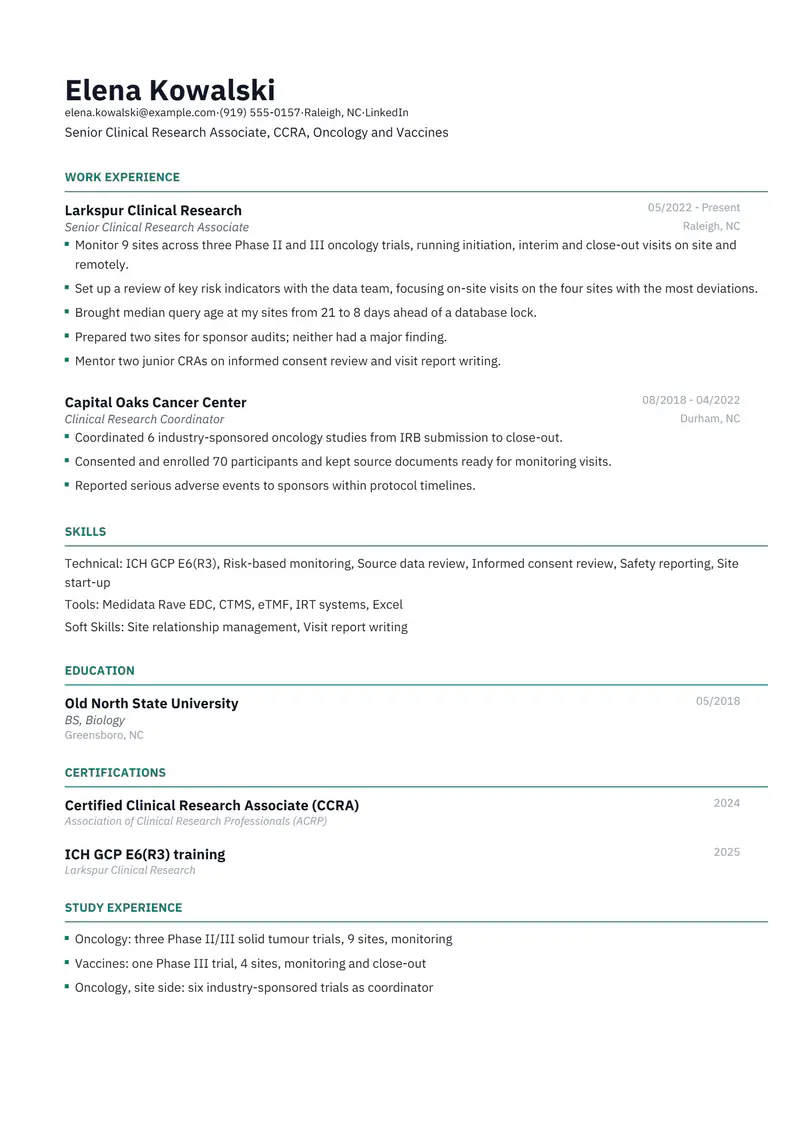
Catalyst fits experienced clinical research staff: it prints no summary and opens on your current studies, so phase, therapeutic area and site count come first. The fictional sample is a senior clinical research associate at a contract research organisation who monitors oncology and vaccine trials after four years as a site coordinator, with risk-based visits, faster query resolution and audit-ready sites. Coordinators can keep the same structure.
Download the clinical research sample
Elena is a fictional senior clinical research associate. Replace every detail with your own before you send it.
The files are made in your browser by Resumity's own exporters, from this sample. The builder opens it as your own resume: click any line to replace it. Free plan, no watermark.
Why Catalyst suits a clinical research resume
Catalyst goes from the header straight into work experience and prints no summary, so a sponsor or CRO recruiter meets your current trials (phases, indications, number of sites) before anything else. For a CRA with several years of monitoring that is the strongest evidence, and the labelled skill rows that follow give the EDC and CTMS systems a clear home.
Second choice: Leslie. Leslie keeps a summary above the experience, which helps a nurse or coordinator explain a move into monitoring.
What goes in each section, in Catalyst's order
Catalyst prints its sections in a fixed order, the same in the PDF and the Word file. Here is that order for this sample, and what to put in each section.
- Work Experience. With no summary printed, the headline carries title and credential: "Senior Clinical Research Associate, CCRA". For each role give phases, indications, number of sites and the visits you run (selection, initiation, interim, close-out). Then the outcomes a sponsor tracks: enrolment, query age, deviations caught early, audit results.
- Skills. Technical holds GCP and monitoring skills (ICH E6(R3), risk-based monitoring, source data review, consent review, safety reporting). Tools holds the systems by name: Medidata Rave or another EDC, CTMS, eTMF, IRT. Postings filter on these names, so match their spelling.
- Education. One line: degree, field, school, year. Nursing, pharmacy and life science degrees are the usual routes into monitoring; a nurse can add the license to the headline, since clinical practice strengthens the application.
- Certifications. ACRP offers the CCRA for monitors and the CCRC for site coordinators. Its 2024 handbook asks CCRA candidates for at least 3,000 hours of CRA work, so the credential confirms a monitoring history the reader can trust. Add current GCP training with its year.
- Study experience. A short study list (indication, phase, number of sites, your role) lets a sponsor match you to a new trial quickly. Leave sponsor and product names out unless the trial is public and your employer allows it.
The sample resume as text
The same content as the files above, so you can copy a line or compare it with your own.
Elena Kowalski
Senior Clinical Research Associate, CCRA, Oncology and Vaccines
Raleigh, NC | elena.kowalski@example.com | (919) 555-0157 | linkedin.com/in/sample-elena-kowalski
Experience
Senior Clinical Research Associate, Larkspur Clinical Research, Raleigh, NC (05/2022 to Present)
- Monitor 9 sites across three Phase II and III oncology trials, running initiation, interim and close-out visits on site and remotely.
- Set up a review of key risk indicators with the data team, focusing on-site visits on the four sites with the most deviations.
- Brought median query age at my sites from 21 to 8 days ahead of a database lock.
- Prepared two sites for sponsor audits; neither had a major finding.
- Mentor two junior CRAs on informed consent review and visit report writing.
Clinical Research Coordinator, Capital Oaks Cancer Center, Durham, NC (08/2018 to 04/2022)
- Coordinated 6 industry-sponsored oncology studies from IRB submission to close-out.
- Consented and enrolled 70 participants and kept source documents ready for monitoring visits.
- Reported serious adverse events to sponsors within protocol timelines.
Study experience
- Oncology: three Phase II/III solid tumour trials, 9 sites, monitoring
- Vaccines: one Phase III trial, 4 sites, monitoring and close-out
- Oncology, site side: six industry-sponsored trials as coordinator
Education
BS, Biology, Old North State University (05/2018)
Certifications
- Certified Clinical Research Associate (CCRA), Association of Clinical Research Professionals (ACRP) (2024)
- ICH GCP E6(R3) training, Larkspur Clinical Research (2025)
Skills
ICH GCP E6(R3), Risk-based monitoring, Source data review, Informed consent review, Safety reporting, Site start-up, Medidata Rave EDC, CTMS, eTMF, IRT systems, Excel, Site relationship management, Visit report writing
How to make the sample yours
Count sites and visits
Sponsors judge monitoring capacity by the number of sites, visit frequency and travel. Replace the sample's 9 sites across three trials with your own figures, and say how many visits were on site and how many remote.
Use the language of E6(R3)
The revised GCP guideline, which FDA issued as final guidance in September 2025, puts weight on building quality in and on risk-proportionate approaches. If you used key risk indicators, centralised review or targeted source data verification, say so in those words.
Translate coordinator work into monitoring terms
Coordinators already handle consent, source documents, query resolution and IRB submissions, which is exactly what a CRA reviews. Write those bullets from the quality side: errors prevented, queries closed, audits passed.
Coming from nursing, pharmacy or the lab
Clinical staff bring protocol discipline, adverse event recognition and careful documentation. Name the patient population and any studies you supported, and complete GCP training before you apply.
State your region and travel
Field CRA roles are tied to a region. Keep your base city in the header and mention travel or home-based work in a bullet if the posting raises it.
Keywords to keep where they are true
Terms this kind of resume is usually searched for. Use the posting's exact wording, and only for work you have done.
- clinical research
- ICH GCP E6(R3)
- site monitoring
- risk-based monitoring
- source data verification
- site initiation visit
- informed consent
- protocol deviations
- serious adverse event reporting
- EDC
- CTMS
- eTMF
- IRB submissions
- query resolution
- inspection readiness
Mistakes to avoid
- A profile paragraph: Catalyst leaves it out, so the headline has to say CRA, therapeutic focus and credential.
- Sponsor names, compound codes or unpublished results.
- Calling site support "monitoring"; ACRP counts only CRA duties performed on behalf of a sponsor toward its CCRA hours.
- A list of SOP trainings in place of the trials you actually worked on.
How the sample PDF reads in text extractors
We exported this sample with Resumity's PDF exporter in Chrome on 2026-10-29 and read the file back with three open-source text extractors. This shows whether software that turns a PDF into text can recover it; it is not a test of any commercial applicant tracking system. How we test templates.
| Extractor | Name, email, phone | Headings | Bullets intact |
|---|---|---|---|
| pdf.js 4.10.38 | All found | 5 of 5 | 8 of 8 |
| pdftotext (Xpdf) 4.00 | All found | 5 of 5 | 8 of 8 |
| pypdf 6.13.0 | All found | 5 of 5 | 8 of 8 |
Frequently asked questions
How do I get into clinical research without research experience?
Start where your background fits: nurses and pharmacists often move into coordinator roles, lab staff into specimen or data roles, administrators into regulatory or start-up work. Complete GCP training and describe your current job in research terms: protocols, documentation, consent and safety.
Should a CRA list every study they have monitored?
List them in a short study experience section grouped by indication and phase, with site counts. Ten one-line entries are fine; full protocol titles are not needed.
What should I say about ICH E6(R3)?
Mention it where you have used its ideas: risk-based monitoring, quality by design, centralised data review. Listing it as a skill with nothing in the bullets to back it adds little.
Do I need a certification to work as a CRA?
Most CRA jobs do not require one to start. ACRP's CCRA needs documented hours of monitoring work, so it is something you earn after a few years and then add to the headline.
How do I show remote monitoring experience?
Say how many visits were remote, what you reviewed (EDC data, eConsent, remote source) and what it caught. Remote and centralised review are now part of trial oversight, so the work deserves its own bullet.
Will applicant tracking systems read this Catalyst PDF?
The sample PDF read back with its contact details, all 5 section headings and all 8 bullets intact in three open-source text extractors (pdf.js, pdftotext and pypdf). Commercial systems such as Workday, Greenhouse or Taleo were not tested, and each employer configures its own.
Guides and templates for this resume
Sources, checked 29 October 2026
We opened every page below on that date. Pay, rules and requirements change, so check the source before you rely on a detail.
- U.S. Food and Drug Administration: E6(R3) Good Clinical Practice (GCP) (final guidance issued September 2025; supports risk-proportionate approaches, quality built in from the start and clarifies sponsor and investigator responsibilities)
- Association of Clinical Research Professionals (ACRP): ACRP Certification (CCRA (Certified Clinical Research Associate) for monitoring trials; CCRC (Certified Clinical Research Coordinator) for coordinating trial activities in adherence to GCP)
- Association of Clinical Research Professionals (ACRP): ACRP Certification Handbook (2024) (CCRA applicants document a minimum of 3,000 hours performing CRA essential duties, on behalf of the sponsor; found via search on the checked date)
More in resume templates by industry.