Resume template · Updated October 2026
Insurance resume template
Short answer
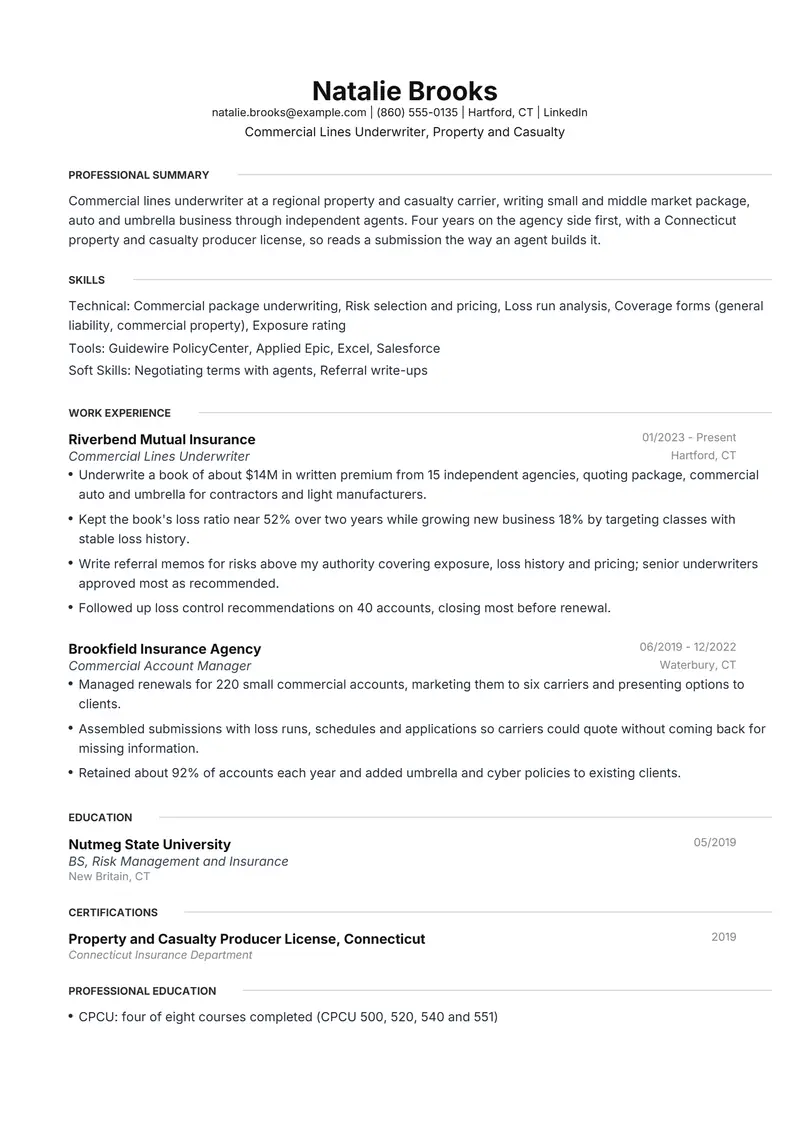
Meridian fits most insurance resumes: labelled skill rows above the jobs put lines of business, policy systems and coverage knowledge where a reader looks first, and the page prints cleanly in grey. The fictional sample moved from account manager at an independent agency to commercial lines underwriter at a regional carrier, with written premium, loss ratio, referral memos, a state producer license and CPCU courses in progress.
Download the insurance sample
Natalie is a fictional commercial lines underwriter. Replace every detail with your own before you send it.
The files are made in your browser by Resumity's own exporters, from this sample. The builder opens it as your own resume: click any line to replace it. Free plan, no watermark.
Why Meridian suits an insurance resume
Meridian prints labelled skill rows (Technical, Tools, Soft Skills) above work experience, so the coverage forms, lines of business and policy systems you know are read first, and those are what separate one insurance candidate from another. With no colour anywhere, it photocopies cleanly for the underwriting manager or agency principal who prefers paper.
Second choice: Henrietta. Henrietta prints experience before skills in a conventional business layout, better when your book of business is the main argument.
What goes in each section, in Meridian's order
Meridian prints its sections in a fixed order, the same in the PDF and the Word file. Here is that order for this sample, and what to put in each section.
- Professional Summary. Name your side of the business (carrier, agency or broker, claims, reinsurance), the lines you work (personal, commercial, specialty, life and health) and the customer size. Insurance jobs look alike from outside and differ sharply inside, and lines of business are the first thing a hiring manager checks.
- Skills. Technical holds the underwriting or claims craft: risk selection, coverage forms, loss run analysis, reserving. Tools holds the policy and agency management systems (Guidewire, Applied Epic, Duck Creek) and rating tools you work in daily.
- Work Experience. Insurance results come in units everyone in the industry knows: written premium, loss ratio, retention, policy count, quote hit ratio, claim cycle time or closure rate. Pair growth with loss experience, because premium growth on its own can read as loose risk selection.
- Education. A risk management and insurance degree helps but is far from required; plenty of people enter with other degrees. One line.
- Certifications. List each producer license with its state and line, for example property and casualty. Meridian prints this after education, so mention an active license in the summary too if the job requires one.
- Professional education. Designations in progress belong here. The Institutes set CPCU as eight courses plus an ethics requirement, so a count of courses passed is the honest way to show progress.
The sample resume as text
The same content as the files above, so you can copy a line or compare it with your own.
Natalie Brooks
Commercial Lines Underwriter, Property and Casualty
Hartford, CT | natalie.brooks@example.com | (860) 555-0135 | linkedin.com/in/sample-natalie-brooks
Commercial lines underwriter at a regional property and casualty carrier, writing small and middle market package, auto and umbrella business through independent agents. Four years on the agency side first, with a Connecticut property and casualty producer license, so reads a submission the way an agent builds it.
Experience
Commercial Lines Underwriter, Riverbend Mutual Insurance, Hartford, CT (01/2023 to Present)
- Underwrite a book of about $14M in written premium from 15 independent agencies, quoting package, commercial auto and umbrella for contractors and light manufacturers.
- Kept the book's loss ratio near 52% over two years while growing new business 18% by targeting classes with stable loss history.
- Write referral memos for risks above my authority covering exposure, loss history and pricing; senior underwriters approved most as recommended.
- Followed up loss control recommendations on 40 accounts, closing most before renewal.
Commercial Account Manager, Brookfield Insurance Agency, Waterbury, CT (06/2019 to 12/2022)
- Managed renewals for 220 small commercial accounts, marketing them to six carriers and presenting options to clients.
- Assembled submissions with loss runs, schedules and applications so carriers could quote without coming back for missing information.
- Retained about 92% of accounts each year and added umbrella and cyber policies to existing clients.
Professional education
- CPCU: four of eight courses completed (CPCU 500, 520, 540 and 551)
Education
BS, Risk Management and Insurance, Nutmeg State University (05/2019)
Certifications
- Property and Casualty Producer License, Connecticut, Connecticut Insurance Department (2019)
Skills
Commercial package underwriting, Risk selection and pricing, Loss run analysis, Coverage forms (general liability, commercial property), Exposure rating, Guidewire PolicyCenter, Applied Epic, Excel, Salesforce, Negotiating terms with agents, Referral write-ups
How to make the sample yours
Write licenses with states and lines
Put "Property and Casualty Producer License, Connecticut", not "licensed agent". The NAIC notes that state insurance regulators license producers and that selling in other states has traditionally meant meeting each state's nonresident requirements, so list every state you hold.
Balance growth with profitability
The sample pairs new business growth with a steady loss ratio. If you grew a book, show what happened to losses; if you cleaned one up, show that you kept the good accounts.
Translate agency or broker years for a carrier
Submissions you assembled, markets you approached and renewals you retained show a carrier you understand distribution. Going the other way, underwriting experience gives a broker credibility when placing difficult risks.
Adjust the sample for claims roles
Replace premium and loss ratio with caseload, cycle time, reserve accuracy, litigation rate and subrogation recovered, and list any adjuster license with its state in the same way as a producer license.
Name coverage forms and classes
General liability, commercial property, workers compensation, professional liability; contractors, restaurants, light manufacturing. Specific classes tell a carrier or broker you can work their book without a long ramp-up.
Keywords to keep where they are true
Terms this kind of resume is usually searched for. Use the posting's exact wording, and only for work you have done.
- insurance
- underwriting
- property and casualty
- commercial lines
- written premium
- loss ratio
- risk selection
- loss runs
- producer license
- renewals
- retention
- coverage analysis
- Guidewire
- Applied Epic
- CPCU
Mistakes to avoid
- "Licensed" with no state or line of authority.
- Premium growth with no word on loss ratio or risk quality.
- CPCU after your name before every requirement is met. Show courses passed instead.
- Customer service bullets that could come from any retail job. Name the policies, lines and markets.
How the sample PDF reads in text extractors
We exported this sample with Resumity's PDF exporter in Chrome on 2026-10-29 and read the file back with three open-source text extractors. This shows whether software that turns a PDF into text can recover it; it is not a test of any commercial applicant tracking system. How we test templates.
| Extractor | Name, email, phone | Headings | Bullets intact |
|---|---|---|---|
| pdf.js 4.10.38 | All found | 6 of 6 | 7 of 7 |
| pdftotext (Xpdf) 4.00 | All found | 6 of 6 | 7 of 7 |
| pypdf 6.13.0 | All found | 6 of 6 | 7 of 7 |
Frequently asked questions
How do I get into insurance from another industry?
Customer service, sales, finance and healthcare backgrounds all translate into claims, account management and underwriting trainee roles. Getting a producer license in your state before applying shows commitment, and your old bullets should stress accuracy, negotiation and handling complaints.
Do I need a license to work in insurance?
If you sell insurance as a producer, yes: state insurance regulators license producers. Many carrier roles, such as underwriting, analytics and operations, do not require one, though some employers prefer it.
What does a broker resume need that a carrier resume does not?
Placement and client results: accounts placed, markets approached, renewal retention, new commission revenue and coverage problems you solved for a client. Carriers care more about risk selection and loss results.
Should I list CPCU while I am still studying?
Yes, as courses completed, with a target date if you have one. It signals commitment to property and casualty work; just keep "CPCU" off your name line until you have earned it.
Should I include a loss ratio that looks bad?
Give context rather than hiding it: a book you inherited, a catastrophe year, or the actions you took. A loss ratio that improved after your changes can be the strongest line on the page.
Will applicant tracking systems read this Meridian PDF?
The sample PDF read back with its contact details, all 6 section headings and all 7 bullets intact in three open-source text extractors (pdf.js, pdftotext and pypdf). Commercial systems such as Workday, Greenhouse or Taleo were not tested, and each employer configures its own.
Guides and templates for this resume
Sources, checked 29 October 2026
We opened every page below on that date. Pay, rules and requirements change, so check the source before you rely on a detail.
- NAIC: Producer Licensing (state insurance regulators license producers; selling in other states historically requires meeting nonresident licensing requirements)
- The Institutes: CPCU (8 courses plus ethics; core courses CPCU 500, 520, 530, 540, 550; concentration courses include 551; 18-24 months to complete)
More in resume templates by industry.