Resume template · Updated October 2026
Telecommunications resume template
Short answer
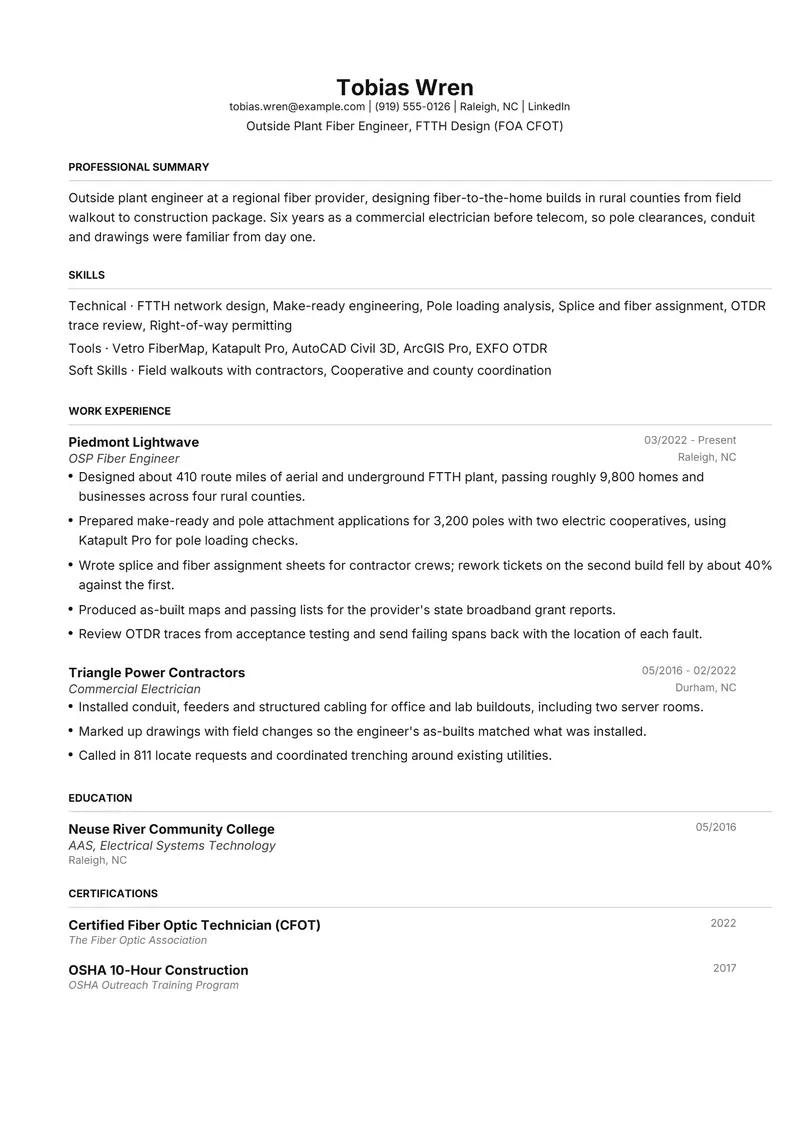
FAANGPath works well for telecommunications resumes because its labelled skill rows (design methods, network software, test equipment) print above every job, and telecom employers screen hard on named tools and standards. The fictional sample is an outside plant fiber engineer in North Carolina who spent six years as an electrician and now designs fiber-to-the-home builds, pole make-ready and the as-built records a grant-funded network has to report.
Download the telecommunications sample
Tobias is a fictional outside plant fiber engineer. Replace every detail with your own before you send it.
The files are made in your browser by Resumity's own exporters, from this sample. The builder opens it as your own resume: click any line to replace it. Free plan, no watermark.
Why FAANGPath suits a telecommunications resume
FAANGPath is built for technical candidates who want their tools read before their jobs. Telecom hiring, whether for fiber design, radio access or IP networks, starts with named platforms and test gear, and the dot after each skill label keeps those rows tidy above a work history that may begin in another trade.
Second choice: Catalyst. Catalyst opens straight on the current job with no summary, a better fit for a senior network or RF engineer whose latest role already proves the case.
What goes in each section, in FAANGPath's order
FAANGPath prints its sections in a fixed order, the same in the PDF and the Word file. Here is that order for this sample, and what to put in each section.
- Professional Summary. Say which layer of the network you work on (outside plant, central office, radio access, IP core, enterprise services) and its scale: route miles, homes passed, sites, subscribers. A carrier, a cable operator, a tower company and a fiber overbuilder all call themselves telecom, so the summary has to place you in one of them.
- Skills. Row one for methods (FTTH design, make-ready, RF planning, IP routing, splicing); row two for named software and equipment (design GIS, pole loading software, OTDRs, network management systems). Write the vendor where it matters: "Cisco IOS XR" or "EXFO OTDR" tells a hiring engineer more than "routers" or "test equipment".
- Work Experience. Use the numbers telecom runs on: homes or businesses passed, route miles designed or built, sites integrated, network availability, mean time to repair, truck rolls avoided, take rate on a new build. Mention permits and field safety once, because the work involves poles, aerial strand, manholes and rights of way.
- Education. An associate degree in electronics or electrical technology is as common here as an engineering degree. One line; time on live networks carries more weight.
- Certifications. FAANGPath prints these at the end, so the one a posting names goes in your headline too. The Fiber Optic Association calls its CFOT the primary certification for fiber optic technicians and lists no prerequisites; BICSI calls the RCDD its flagship design credential for telecommunications distribution design.
The sample resume as text
The same content as the files above, so you can copy a line or compare it with your own.
Tobias Wren
Outside Plant Fiber Engineer, FTTH Design (FOA CFOT)
Raleigh, NC | tobias.wren@example.com | (919) 555-0126 | linkedin.com/in/sample-tobias-wren
Outside plant engineer at a regional fiber provider, designing fiber-to-the-home builds in rural counties from field walkout to construction package. Six years as a commercial electrician before telecom, so pole clearances, conduit and drawings were familiar from day one.
Experience
OSP Fiber Engineer, Piedmont Lightwave, Raleigh, NC (03/2022 to Present)
- Designed about 410 route miles of aerial and underground FTTH plant, passing roughly 9,800 homes and businesses across four rural counties.
- Prepared make-ready and pole attachment applications for 3,200 poles with two electric cooperatives, using Katapult Pro for pole loading checks.
- Wrote splice and fiber assignment sheets for contractor crews; rework tickets on the second build fell by about 40% against the first.
- Produced as-built maps and passing lists for the provider's state broadband grant reports.
- Review OTDR traces from acceptance testing and send failing spans back with the location of each fault.
Commercial Electrician, Triangle Power Contractors, Durham, NC (05/2016 to 02/2022)
- Installed conduit, feeders and structured cabling for office and lab buildouts, including two server rooms.
- Marked up drawings with field changes so the engineer's as-builts matched what was installed.
- Called in 811 locate requests and coordinated trenching around existing utilities.
Education
AAS, Electrical Systems Technology, Neuse River Community College (05/2016)
Certifications
- Certified Fiber Optic Technician (CFOT), The Fiber Optic Association (2022)
- OSHA 10-Hour Construction, OSHA Outreach Training Program (2017)
Skills
FTTH network design, Make-ready engineering, Pole loading analysis, Splice and fiber assignment, OTDR trace review, Right-of-way permitting, Vetro FiberMap, Katapult Pro, AutoCAD Civil 3D, ArcGIS Pro, EXFO OTDR, Field walkouts with contractors, Cooperative and county coordination
How to make the sample yours
Write in passings and route miles
For fiber and cable roles, homes passed, route miles and splice counts tell a reader the size of the builds you handled. For wireless, use sites, sectors and drive-test results; for IP and core, routers, circuits and availability.
Show you know who is funding the build
NTIA describes its Broadband Equity, Access, and Deployment (BEAD) program as a $42.45 billion federal grant program that states use to deploy or upgrade networks in unserved or underserved areas. If you prepared coverage maps, passing lists or subgrant paperwork, one bullet shows you can work on grant-funded projects.
Carry over a trade or IT background
Electricians bring code clearances, conduit and drawings; IT staff bring switching, VLANs and ticketing; utility line workers bring aerial and pole safety. Put those bullets at the top of the older job, as the sample does with structured cabling and 811 locate requests.
Name field safety rules where they apply
OSHA's telecommunications standard (29 CFR 1910.268) covers work at telecommunications centers and field installations, overhead or underground on public or private rights of way, and excludes construction work. If you climbed, worked aerial or entered manholes, list the training you hold rather than calling yourself "safety-minded".
Change the role, keep the structure
A network engineer leads skills with routing protocols and automation and measures availability; an RF engineer leads with planning tools and KPIs such as dropped calls; a telecom project manager with sites delivered against schedule and budget; enterprise sales with circuits sold and contract value.
Keywords to keep where they are true
Terms this kind of resume is usually searched for. Use the posting's exact wording, and only for work you have done.
- telecommunications
- outside plant
- FTTH
- fiber optic design
- make-ready engineering
- pole loading
- splicing
- OTDR
- right of way
- homes passed
- network availability
- 5G
- BEAD
- CFOT
- as-built documentation
Mistakes to avoid
- "Strong technical skills" in place of the systems, tools and test gear you actually used.
- Blurring design and construction. If you drew the plan, say designed; if you placed the cable, say built or installed; if you did both, show both.
- Leaving out climbing, aerial lift or confined space training when you apply for field roles.
- Acronym walls with no context: "GPON, XGS-PON, DWDM, MPLS" in a row says less than one bullet where you used one of them.
How the sample PDF reads in text extractors
We exported this sample with Resumity's PDF exporter in Chrome on 2026-10-29 and read the file back with three open-source text extractors. This shows whether software that turns a PDF into text can recover it; it is not a test of any commercial applicant tracking system. How we test templates.
| Extractor | Name, email, phone | Headings | Bullets intact |
|---|---|---|---|
| pdf.js 4.10.38 | All found | 5 of 5 | 8 of 8 |
| pdftotext (Xpdf) 4.00 | All found | 5 of 5 | 8 of 8 |
| pypdf 6.13.0 | All found | 5 of 5 | 8 of 8 |
Frequently asked questions
How do I get into telecom from electrical work or IT?
Both routes are common. Electricians move into outside plant, splicing and design; IT staff into network operations and engineering. Add one industry credential (CFOT for fiber, a vendor networking certification for IP roles) and rewrite your older bullets around drawings, cabling, switching or field safety.
Is the BICSI RCDD worth listing?
If you design structured cabling or building distribution, yes; BICSI presents it as its flagship design credential. If you are still studying for it, leave it off the certifications list and raise it in the interview.
What metrics matter on a telecom resume?
For builds: homes or businesses passed, route miles, splice counts and schedule. For operations: availability, mean time to repair, ticket volumes and repeat truck rolls. For commercial roles: take rate, churn and contract value.
Should I list every network standard I know?
No. List the ones you have configured, designed to or tested against, grouped by area, and leave course-only material to a training line. An interviewer can ask about each one.
How long should a telecommunications resume be?
One page for technicians and early-career engineers, two for senior engineers or managers with several large programs. Keep projects with a clear scale and drop routine ticket counts.
Will applicant tracking systems read this FAANGPath PDF?
The sample PDF read back with its contact details, all 5 section headings and all 8 bullets intact in three open-source text extractors (pdf.js, pdftotext and pypdf). Commercial systems such as Workday, Greenhouse or Taleo were not tested, and each employer configures its own.
Guides and templates for this resume
- Electrician resume
- Electrical Engineer Resume Example, Keywords and Writing Guide
- IT Support Resume Example and Writing Guide
- Technical Skills for a Resume: What Counts and How to List Them
- How to List Certifications and Licenses on a Resume
- Computer Networks Interview Questions and Answers (2026 Edition)
Sources, checked 29 October 2026
We opened every page below on that date. Pay, rules and requirements change, so check the source before you rely on a detail.
- U.S. Government Publishing Office (29 CFR): 29 CFR 1910.268 Telecommunications (covers work at telecommunications centers and field installations, overhead or underground on public or private rights of way; excludes construction work)
- NTIA BroadbandUSA: Broadband Equity, Access, and Deployment (BEAD) Program ($42.45 billion federal grant program; states may fund deployment or upgrades in unserved or underserved areas)
- BICSI: RCDD certification (BICSI's flagship design credential for telecommunications distribution design)
- The Fiber Optic Association: The Fiber Optic Association CFOT Certification (CFOT is the primary FOA certification for fiber optic technicians; prerequisites: none)
More in resume templates by industry.