Resume template · Updated October 2026
Biomedical engineer resume template
Short answer
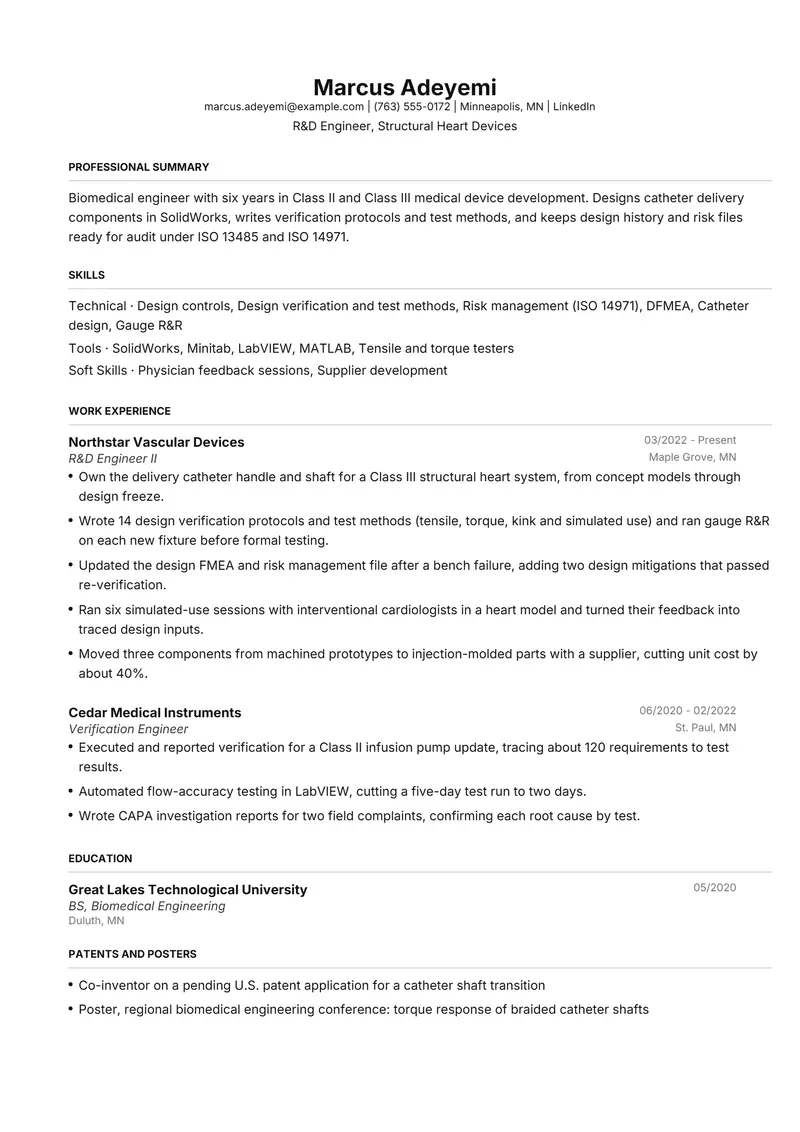
FAANGPath suits a biomedical engineer in medical device development: labelled skill rows for design, testing and quality systems print above the jobs, so a hiring manager sees design controls and test methods before company names. The fictional sample owns a catheter handle and shaft on a structural heart program in Minnesota, after two years verifying an infusion pump update, and lists a pending patent.
Download the biomedical engineer sample
Marcus is a fictional R&D engineer. Replace every detail with your own before you send it.
The files are made in your browser by Resumity's own exporters, from this sample. The builder opens it as your own resume: click any line to replace it. Free plan, no watermark.
Why FAANGPath suits a biomedical engineer resume
FAANGPath prints the summary, then skills as labelled rows, then work experience, which suits a technical candidate whose CAD, test and risk management skills are the first filter. Its centred black-and-grey layout stays readable with dense terms like DFMEA, gauge R&R and design verification, and the custom list at the end holds patents and posters.
Second choice: Henrietta. Henrietta prints education right after the jobs; better for a new graduate or a master's holder whose degree project is the strongest evidence.
What goes in each section, in FAANGPath's order
FAANGPath prints its sections in a fixed order, the same in the PDF and the Word file. Here is that order for this sample, and what to put in each section.
- Professional Summary. Device type and risk class, development stage (concept, design freeze, verification, transfer), years, and the standards you work under. One line on the clinical problem the device solves helps a reader outside your niche.
- Skills. Technical for design controls, verification, risk analysis and the device craft (catheters, implants, electronics, software); Tools for CAD, statistics and test software; Soft Skills for clinician feedback sessions and supplier work.
- Work Experience. Name the component or subsystem you owned and the documents you wrote: protocols, test methods, risk file updates, reports. Results are design changes that passed, test time cut, cost reduced or complaints closed.
- Education. Degree, school and year, with the senior design or thesis project on a detail line while it is recent. A master's in biomedical or mechanical engineering sits here too.
- Patents and Posters. Patents, patent applications, posters and papers, each in one line. Describe a pending application as pending; never imply it has been granted.
The sample resume as text
The same content as the files above, so you can copy a line or compare it with your own.
Marcus Adeyemi
R&D Engineer, Structural Heart Devices
Minneapolis, MN | marcus.adeyemi@example.com | (763) 555-0172 | linkedin.com/in/sample-marcus-adeyemi
Biomedical engineer with six years in Class II and Class III medical device development. Designs catheter delivery components in SolidWorks, writes verification protocols and test methods, and keeps design history and risk files ready for audit under ISO 13485 and ISO 14971.
Experience
R&D Engineer II, Northstar Vascular Devices, Maple Grove, MN (03/2022 to Present)
- Own the delivery catheter handle and shaft for a Class III structural heart system, from concept models through design freeze.
- Wrote 14 design verification protocols and test methods (tensile, torque, kink and simulated use) and ran gauge R&R on each new fixture before formal testing.
- Updated the design FMEA and risk management file after a bench failure, adding two design mitigations that passed re-verification.
- Ran six simulated-use sessions with interventional cardiologists in a heart model and turned their feedback into traced design inputs.
- Moved three components from machined prototypes to injection-molded parts with a supplier, cutting unit cost by about 40%.
Verification Engineer, Cedar Medical Instruments, St. Paul, MN (06/2020 to 02/2022)
- Executed and reported verification for a Class II infusion pump update, tracing about 120 requirements to test results.
- Automated flow-accuracy testing in LabVIEW, cutting a five-day test run to two days.
- Wrote CAPA investigation reports for two field complaints, confirming each root cause by test.
Patents and Posters
- Co-inventor on a pending U.S. patent application for a catheter shaft transition
- Poster, regional biomedical engineering conference: torque response of braided catheter shafts
Education
BS, Biomedical Engineering, Great Lakes Technological University (05/2020). Senior design: low-cost neonatal pulse oximeter
Skills
Design controls, Design verification and test methods, Risk management (ISO 14971), DFMEA, Catheter design, Gauge R&R, SolidWorks, Minitab, LabVIEW, MATLAB, Tensile and torque testers, Physician feedback sessions, Supplier development
How to make the sample yours
Say which part of the device was yours
Handle, shaft, sensor board, algorithm, packaging. "Worked on a cardiac device" tells a hiring manager nothing about what you can own on their team.
List the documents you wrote
Design inputs, verification protocols, test method validations, risk file updates, CAPA reports. Medical device engineering runs on paper, and readers look for proof you can produce it.
Keep stage and class visible
Concept, design freeze, verification, transfer to manufacturing; Class II or Class III. The same title means different work at each stage.
Tilt toward R&D, quality or manufacturing
R&D roles want design and testing; quality roles want CAPA, complaints and audits; manufacturing roles want process validation and yield. Reorder bullets for the posting.
Show work with clinicians
Simulated-use labs, physician interviews, observing procedures. It shows you design for real users, which reviewers of human factors work care about.
Keywords to keep where they are true
Terms this kind of resume is usually searched for. Use the posting's exact wording, and only for work you have done.
- biomedical engineer
- medical device design
- design controls
- design verification
- test method validation
- ISO 13485
- ISO 14971
- risk management
- DFMEA
- CAPA
- SolidWorks
- Minitab
- LabVIEW
- design history file
- gauge R&R
Mistakes to avoid
- Calling yourself a biomedical engineer with no device, component or stage named.
- Listing ISO standards as skills without one thing you produced under them.
- Revealing confidential product names or unreleased clinical data.
- Describing a patent application as a granted patent.
How the sample PDF reads in text extractors
We exported this sample with Resumity's PDF exporter in Chrome on 2026-10-29 and read the file back with three open-source text extractors. This shows whether software that turns a PDF into text can recover it; it is not a test of any commercial applicant tracking system. How we test templates.
| Extractor | Name, email, phone | Headings | Bullets intact |
|---|---|---|---|
| pdf.js 4.10.38 | All found | 5 of 5 | 8 of 8 |
| pdftotext (Xpdf) 4.00 | All found | 5 of 5 | 8 of 8 |
| pypdf 6.13.0 | All found | 5 of 5 | 8 of 8 |
Frequently asked questions
Should I put ISO 13485 and ISO 14971 on a biomedical engineer resume?
Yes, tied to work you did under them. ISO 13485:2016 sets quality management system requirements for medical devices for regulatory purposes, and ISO 14971:2019 covers applying risk management to medical devices. "Updated the risk management file after a bench failure" says more than either standard number on its own.
How do I describe a device I cannot name?
Give the device type, risk class, development stage and your component: "delivery catheter handle for a Class III structural heart system". Hiring managers expect confidentiality and can judge the work without the product name.
How is an R&D biomedical engineer resume different from a quality engineer resume?
R&D resumes lead with design, prototyping and verification; quality resumes lead with CAPA, complaints, audits and supplier quality. Many engineers do some of both, so put the half the posting wants in the summary and the top bullets.
How can a new graduate show design controls experience?
Use the senior design project: user needs, design inputs, a verification test you wrote, a risk analysis, a design review. A short custom list of those documents under the project reads like early industry work.
Should I list patents and conference posters?
Yes, in a short list at the end, one line each. Mark applications as pending, and keep posters to the ones related to the job you want.
Will applicant tracking systems read this FAANGPath PDF?
The sample PDF read back with its contact details, all 5 section headings and all 8 bullets intact in three open-source text extractors (pdf.js, pdftotext and pypdf). Commercial systems such as Workday, Greenhouse or Taleo were not tested, and each employer configures its own.
Guides and templates for this resume
Sources, checked 29 October 2026
We opened every page below on that date. Pay, rules and requirements change, so check the source before you rely on a detail.
- ISO: ISO 13485:2016 Medical devices: Quality management systems: Requirements for regulatory purposes (the standard for medical device quality management systems, written for regulatory purposes)
- ISO: ISO 14971:2019 Medical devices: Application of risk management to medical devices (the standard for applying risk management to medical devices)
More in resume templates by job title.