Resume template · Updated October 2026
Fashion industry resume template
Short answer
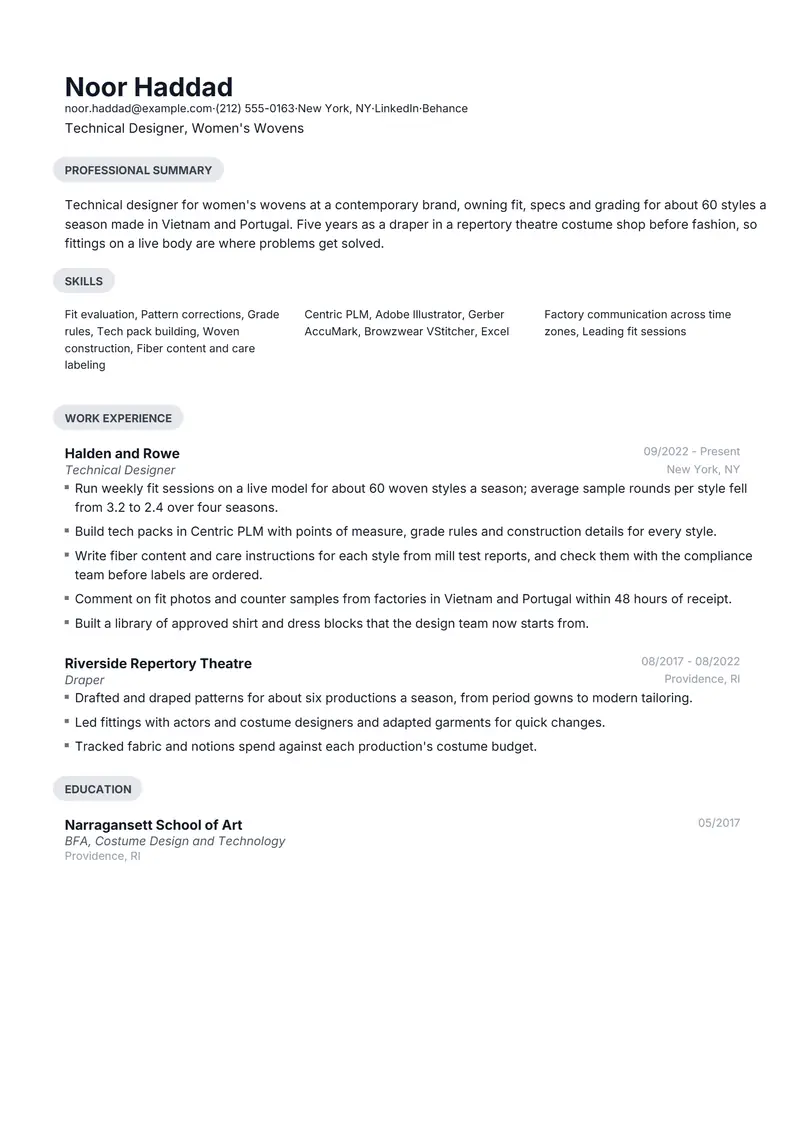
Daniel suits fashion resumes in design, product development and merchandising: Resumity suggests it for designers, and its skills grid puts PLM, pattern and design software above the jobs. The fictional sample is a technical designer for women's wovens in New York who started as a draper in a theatre costume shop, with fit sessions, tech packs, sample rounds and labeling work written for a brand.
Download the fashion sample
Noor is a fictional technical designer. Replace every detail with your own before you send it.
The files are made in your browser by Resumity's own exporters, from this sample. The builder opens it as your own resume: click any line to replace it. Free plan, no watermark.
Why Daniel suits a fashion resume
Daniel is the template Resumity suggests for designers who want a softer page than rules alone: section headings sit in rounded grey pills, and a three-column skills grid prints before work experience. Fashion teams screen on software (PLM, Illustrator, pattern systems) and construction knowledge, so the grid answers them early while the portfolio carries the visuals.
Second choice: Henrietta. Henrietta is the conventional business layout, with education right after experience, a better fit for buyers, planners and merchandisers whose numbers matter more than looks.
What goes in each section, in Daniel's order
Daniel prints its sections in a fixed order, the same in the PDF and the Word file. Here is that order for this sample, and what to put in each section.
- Professional Summary. Say your discipline (design, technical design, product development, sourcing, buying, planning, visual merchandising), the category (women's wovens, denim, footwear, kidswear) and the market tier, from mass to luxury. Fashion teams are organised by category, so "fashion professional" leaves them guessing.
- Skills. The grid has no labels: methods in the first column (fit evaluation, grading, costing, trend research, assortment planning), named software in the second (a PLM such as Centric, Illustrator, Gerber or Lectra, a 3D tool such as Browzwear or CLO), people skills in the third. List only systems you have used on real styles.
- Work Experience. Use the numbers each team is judged on: styles per season, sample rounds, lead time, cost against target, sell-through, margin, markdowns. Name the countries your factories are in or the number of vendors, without trade secrets.
- Education. Fashion design, merchandising, textile and costume degrees are common. One line, with a senior collection or award in the detail if you are early in your career.
The sample resume as text
The same content as the files above, so you can copy a line or compare it with your own.
Noor Haddad
Technical Designer, Women's Wovens
New York, NY | noor.haddad@example.com | (212) 555-0163 | linkedin.com/in/sample-noor-haddad | behance.net/sample-noor-haddad
Technical designer for women's wovens at a contemporary brand, owning fit, specs and grading for about 60 styles a season made in Vietnam and Portugal. Five years as a draper in a repertory theatre costume shop before fashion, so fittings on a live body are where problems get solved.
Experience
Technical Designer, Halden and Rowe, New York, NY (09/2022 to Present)
- Run weekly fit sessions on a live model for about 60 woven styles a season; average sample rounds per style fell from 3.2 to 2.4 over four seasons.
- Build tech packs in Centric PLM with points of measure, grade rules and construction details for every style.
- Write fiber content and care instructions for each style from mill test reports, and check them with the compliance team before labels are ordered.
- Comment on fit photos and counter samples from factories in Vietnam and Portugal within 48 hours of receipt.
- Built a library of approved shirt and dress blocks that the design team now starts from.
Draper, Riverside Repertory Theatre, Providence, RI (08/2017 to 08/2022)
- Drafted and draped patterns for about six productions a season, from period gowns to modern tailoring.
- Led fittings with actors and costume designers and adapted garments for quick changes.
- Tracked fabric and notions spend against each production's costume budget.
Education
BFA, Costume Design and Technology, Narragansett School of Art (05/2017)
Skills
Fit evaluation, Pattern corrections, Grade rules, Tech pack building, Woven construction, Fiber content and care labeling, Centric PLM, Adobe Illustrator, Gerber AccuMark, Browzwear VStitcher, Excel, Factory communication across time zones, Leading fit sessions
How to make the sample yours
Link a portfolio that matches the job
Designers show sketches and finished garments; technical designers show a sample tech pack page with measurements and comments; merchandisers show an assortment plan with the numbers blurred. Put one link in the header.
Show you know the labeling rules
Under the FTC's Textile and Wool Act rules, labels must give fiber content, country of origin and either the company name or its Registered Identification Number, with the origin on the front of the label. The Care Labeling Rule requires manufacturers and importers to attach care instructions with a reasonable basis behind them. If you wrote or checked labels, say so.
Translate a costume, retail or graphics background
Theatre drapers bring fitting and pattern work; retail staff bring customer and sell-through knowledge; graphic designers bring Illustrator and print. Lead the older job with the skill a brand team uses, as the sample does with draping and fittings.
Name your factories and seasons
Countries of production, number of vendors and the seasons you worked on (Spring 2025, Holiday 2025) show the calendar you have lived. Keep confidential costs and supplier names out.
Switch the role, keep the evidence
A buyer leads with sales, margin and sell-through on a category; a planner with forecast accuracy and inventory turns; a designer with styles taken to production and best sellers; a sourcing specialist with cost savings, lead times and factory audits.
Keywords to keep where they are true
Terms this kind of resume is usually searched for. Use the posting's exact wording, and only for work you have done.
- technical design
- tech packs
- fit sessions
- points of measure
- grading
- PLM
- Adobe Illustrator
- product development
- sample rounds
- costing
- sell-through
- sourcing
- care labels
- fiber content
- 3D design
Mistakes to avoid
- A resume built from images, with little text a reader can search. Keep the page plain and let the portfolio carry the visuals.
- Name-dropping a famous house from an internship without saying what you did there.
- Listing 3D or pattern software from one class as a working skill.
- Sharing costs, factory names or unreleased designs from a past employer.
How the sample PDF reads in text extractors
We exported this sample with Resumity's PDF exporter in Chrome on 2026-10-29 and read the file back with three open-source text extractors. This shows whether software that turns a PDF into text can recover it; it is not a test of any commercial applicant tracking system. How we test templates.
| Extractor | Name, email, phone | Headings | Bullets intact |
|---|---|---|---|
| pdf.js 4.10.38 | All found | 4 of 4 | 8 of 8 |
| pdftotext (Xpdf) 4.00 | All found | 4 of 4 | 8 of 8 |
| pypdf 6.13.0 | All found | 4 of 4 | 8 of 8 |
Frequently asked questions
Should a fashion resume be creative?
Keep the resume itself clean and readable, and put the creativity in your portfolio. Hiring teams search the page for software, category and seasons; a layout built from images hides those.
How do I move into fashion from costume, retail or graphic design?
Pick the brand role closest to your skill (technical design or patternmaking from costume, merchandising from retail, print design from graphics) and rewrite your older bullets around it. A small portfolio built for that role matters more than another course.
Do I need to list every season I worked on?
No. Give the date range for each job and name seasons only in bullets where they explain a result, such as a launch or a best seller.
What numbers matter on a fashion resume?
For product roles: styles per season, sample rounds, lead time and cost against target. For buying and planning: sales, margin, sell-through and markdown rate. For retail and visual teams: store sales and conversion.
How long should a fashion resume be?
One page with a portfolio link for most roles. Directors with several brands behind them can use two.
Will applicant tracking systems read this Daniel PDF?
The sample PDF read back with its contact details, all 4 section headings and all 8 bullets intact in three open-source text extractors (pdf.js, pdftotext and pypdf). Commercial systems such as Workday, Greenhouse or Taleo were not tested, and each employer configures its own.
Guides and templates for this resume
Sources, checked 29 October 2026
We opened every page below on that date. Pay, rules and requirements change, so check the source before you rely on a detail.
- Federal Trade Commission: Threading Your Way Through the Labeling Requirements Under the Textile and Wool Acts (labels must identify fiber content, country of origin and either the company name or RN; country of origin on the front of the label)
- Federal Trade Commission: Clothes Captioning: Complying with the Care Labeling Rule (manufacturers and importers must attach care instructions to clothing and have a reasonable basis for them)
More in resume templates by industry.