Resume template · Updated October 2026
Oil and gas resume template
Short answer
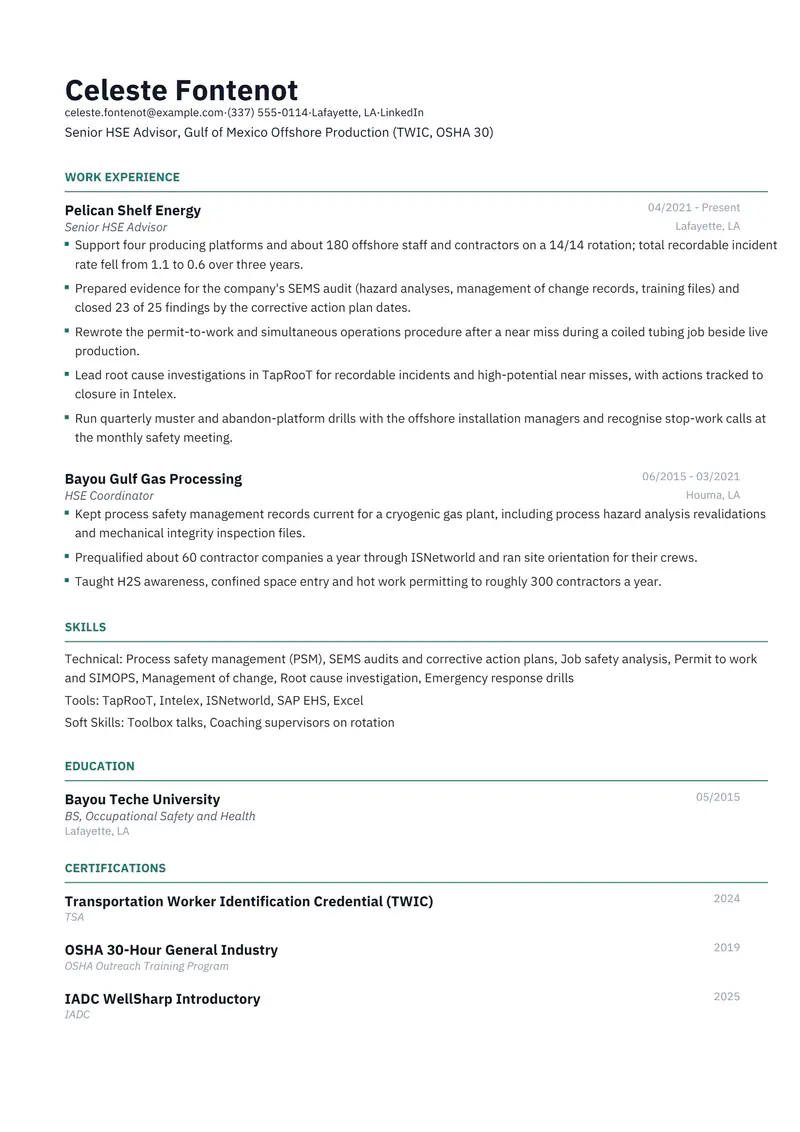
Catalyst suits most oil and gas resumes from people with a few years in the field: it skips the summary and opens on the current job, where safety record, rotation and the assets you cover do the persuading. The fictional sample is a senior HSE advisor on Gulf of Mexico production platforms who began at an onshore gas plant, so both offshore SEMS work and onshore PSM records appear in her bullets.
Download the oil and gas sample
Celeste is a fictional senior HSE advisor. Replace every detail with your own before you send it.
The files are made in your browser by Resumity's own exporters, from this sample. The builder opens it as your own resume: click any line to replace it. Free plan, no watermark.
Why Catalyst suits an oil and gas resume
Catalyst prints no summary and starts straight on work experience, which suits field and office staff in oil and gas whose latest posting (the platform, plant or basin, the crew size, the incident record) is the case for hiring them. Skills follow as labelled rows under teal headings, so permits, standards and software still get a clear block.
Second choice: Leslie. Leslie also puts experience ahead of skills but keeps a summary paragraph, useful if you are crossing in from the military, construction or manufacturing and need two sentences to explain the move.
What goes in each section, in Catalyst's order
Catalyst prints its sections in a fixed order, the same in the PDF and the Word file. Here is that order for this sample, and what to put in each section.
- Work Experience. With Catalyst the page opens here, so the headline does a summary's job: role, asset type (offshore platforms, onshore pads, a gas plant, a refinery) and the card or certificate the posting asks for. Then write each bullet in the industry's own measures: recordable and lost-time rates, barrels or BOE a day, uptime, non-productive time, audit findings closed. Employers in every discipline here read for safety first, so even an engineer or planner should keep one bullet on a hazard they controlled.
- Skills. Technical holds the methods of the work: job safety analysis, management of change, permit to work and SIMOPS for HSE; nodal analysis or artificial lift for production engineers; well planning for drilling. Tools holds the software operators run on, such as ISNetworld or Avetta for contractor prequalification, an incident system, SAP for maintenance, Petrel or WellView for subsurface and drilling. A superintendent reads this block to check you can start without retraining.
- Education. One line. Petroleum, chemical or mechanical engineering, geology and occupational safety degrees are common, but many operators, technicians and HSE staff came up through the field or the military, and the certificates below carry as much weight.
- Certifications. Catalyst prints these at the very bottom, so repeat the ones that decide whether you can be mobilised (a TWIC card for offshore and port work, well control certification for rig roles) in the headline. Date every entry: IADC describes its WellSharp program as working within a two-year cycle between well control certifications, and crews check expiry before anyone travels.
The sample resume as text
The same content as the files above, so you can copy a line or compare it with your own.
Celeste Fontenot
Senior HSE Advisor, Gulf of Mexico Offshore Production (TWIC, OSHA 30)
Lafayette, LA | celeste.fontenot@example.com | (337) 555-0114 | linkedin.com/in/sample-celeste-fontenot
Experience
Senior HSE Advisor, Pelican Shelf Energy, Lafayette, LA (04/2021 to Present)
- Support four producing platforms and about 180 offshore staff and contractors on a 14/14 rotation; total recordable incident rate fell from 1.1 to 0.6 over three years.
- Prepared evidence for the company's SEMS audit (hazard analyses, management of change records, training files) and closed 23 of 25 findings by the corrective action plan dates.
- Rewrote the permit-to-work and simultaneous operations procedure after a near miss during a coiled tubing job beside live production.
- Lead root cause investigations in TapRooT for recordable incidents and high-potential near misses, with actions tracked to closure in Intelex.
- Run quarterly muster and abandon-platform drills with the offshore installation managers and recognise stop-work calls at the monthly safety meeting.
HSE Coordinator, Bayou Gulf Gas Processing, Houma, LA (06/2015 to 03/2021)
- Kept process safety management records current for a cryogenic gas plant, including process hazard analysis revalidations and mechanical integrity inspection files.
- Prequalified about 60 contractor companies a year through ISNetworld and ran site orientation for their crews.
- Taught H2S awareness, confined space entry and hot work permitting to roughly 300 contractors a year.
Education
BS, Occupational Safety and Health, Bayou Teche University (05/2015)
Certifications
- Transportation Worker Identification Credential (TWIC), TSA (2024)
- OSHA 30-Hour General Industry, OSHA Outreach Training Program (2019)
- IADC WellSharp Introductory, IADC (2025)
Skills
Process safety management (PSM), SEMS audits and corrective action plans, Job safety analysis, Permit to work and SIMOPS, Management of change, Root cause investigation, Emergency response drills, TapRooT, Intelex, ISNetworld, SAP EHS, Excel, Toolbox talks, Coaching supervisors on rotation
How to make the sample yours
Name the asset and the basin
Permian pads, deepwater platforms, a Bakken gathering system and a Gulf Coast refinery are different jobs with different hazards. Put yours in the headline and the first bullet of each role, then swap in the posting's wording where your skills carry over.
Match the rule set to the site
OSHA's Process Safety Management standard (29 CFR 1910.119) covers processes holding listed highly hazardous chemicals or 10,000 pounds or more of flammable liquids or gases, such as gas plants and refineries, and expressly exempts oil or gas well drilling and servicing. Offshore, BSEE requires operators on the Outer Continental Shelf to run a Safety and Environmental Management System under 30 CFR 250 Subpart S. Use the vocabulary of the one you actually worked under.
Translate another heavy industry
Navy engineering ratings, power plants, chemical manufacturing, mining and heavy civil work all run permits, lockout and confined space entry. Lead the older job with those bullets and use the oil and gas term for each (a plant outage becomes a turnaround, a hazard analysis becomes a JSA).
State your rotation and mobility
Field roles often run on hitches such as 14/14 or 21/21, or need travel to remote sites. If you have worked a rotation, put it in the job line; if you will relocate to Midland, Williston or Houma, put that beside your location.
Change the role, keep the safety thread
Production engineers swap incident rates for decline curves, uptime and lift optimisation; landmen for leases, title work and acreage; supply chain staff for spend and vendor lead times. Every version keeps one bullet on how the work was done safely, because every discipline is interviewed on it.
Keywords to keep where they are true
Terms this kind of resume is usually searched for. Use the posting's exact wording, and only for work you have done.
- HSE
- process safety management
- SEMS
- job safety analysis
- management of change
- permit to work
- SIMOPS
- stop work authority
- incident investigation
- root cause analysis
- TRIR
- contractor management
- emergency response
- TWIC
- well control
Mistakes to avoid
- "Safety is my top priority" as a claim on its own. Show it with an incident rate, a stop-work call or a permit process you fixed.
- Listing a TWIC card, well control certificate or offshore survival course without a date; recruiters check expiry before they call.
- Writing about "the rig" or "the plant" without saying onshore or offshore, what it produces and how many people work there.
- Describing an incident with names, injury details or blame. State the type, your part and the change that followed.
How the sample PDF reads in text extractors
We exported this sample with Resumity's PDF exporter in Chrome on 2026-10-29 and read the file back with three open-source text extractors. This shows whether software that turns a PDF into text can recover it; it is not a test of any commercial applicant tracking system. How we test templates.
| Extractor | Name, email, phone | Headings | Bullets intact |
|---|---|---|---|
| pdf.js 4.10.38 | All found | 4 of 4 | 8 of 8 |
| pdftotext (Xpdf) 4.00 | All found | 4 of 4 | 8 of 8 |
| pypdf 6.13.0 | All found | 4 of 4 | 8 of 8 |
Frequently asked questions
How do I move into oil and gas from the military or another industry?
Lead with permits, lockout, confined space, maintenance discipline and emergency drills from your past work, and get the entry cards the employer asks for, such as a TWIC for offshore or port work. Put the target role and basin in your headline so the older job title is read in that light.
What safety numbers should go on an oil and gas resume?
Total recordable and lost-time incident rates for the crew or site you were responsible for, with the period. Add leading indicators you drove, such as near-miss reports, stop-work calls or audit findings closed. Never quote company-wide figures as if they were yours alone.
Does an HSE resume need to mention PSM or SEMS?
Only the one you worked under. PSM applies to onshore processes such as gas plants and refineries and excludes drilling and well servicing; SEMS is BSEE's requirement for offshore operators on the Outer Continental Shelf. Naming the wrong one tells a reader you have not been on that kind of site.
Should I list my rotation schedule?
Yes, briefly, in the job line or a bullet ("14/14 offshore rotation"). It shows you have lived the schedule, which hiring managers ask about when they bring in new field staff.
How long should an oil and gas resume be?
Two pages is normal for someone with ten or more years across several assets; one page for a first field job. Keep older roles to the bullets that show a skill the new site needs.
Will applicant tracking systems read this Catalyst PDF?
The sample PDF read back with its contact details, all 4 section headings and all 8 bullets intact in three open-source text extractors (pdf.js, pdftotext and pypdf). Commercial systems such as Workday, Greenhouse or Taleo were not tested, and each employer configures its own.
Guides and templates for this resume
Sources, checked 29 October 2026
We opened every page below on that date. Pay, rules and requirements change, so check the source before you rely on a detail.
- U.S. Government Publishing Office (29 CFR): 29 CFR 1910.119 Process safety management of highly hazardous chemicals (scope covers Appendix A chemicals and 10,000 lb or more of flammable liquids or gases; (a)(2) exempts retail facilities, oil or gas well drilling or servicing operations and normally unoccupied remote facilities)
- Bureau of Safety and Environmental Enforcement: Safety and Environmental Management Systems (SEMS) (SEMS is a performance-based approach to managing offshore operations; rule in 30 CFR Part 250 Subpart S; operators prepare corrective action plans after each audit)
- Transportation Security Administration: TWIC (credential required by the Maritime Transportation Security Act for workers who need unescorted access to secure areas of maritime facilities and vessels)
- IADC: WellSharp (accreditation program for well control training for every person with well control responsibilities; Driller and Supervisor courses; two-year cycle between well control certifications)
More in resume templates by industry.