Resume template · Updated October 2026
Resume template for Japan: the career history beside your rirekisho
Short answer
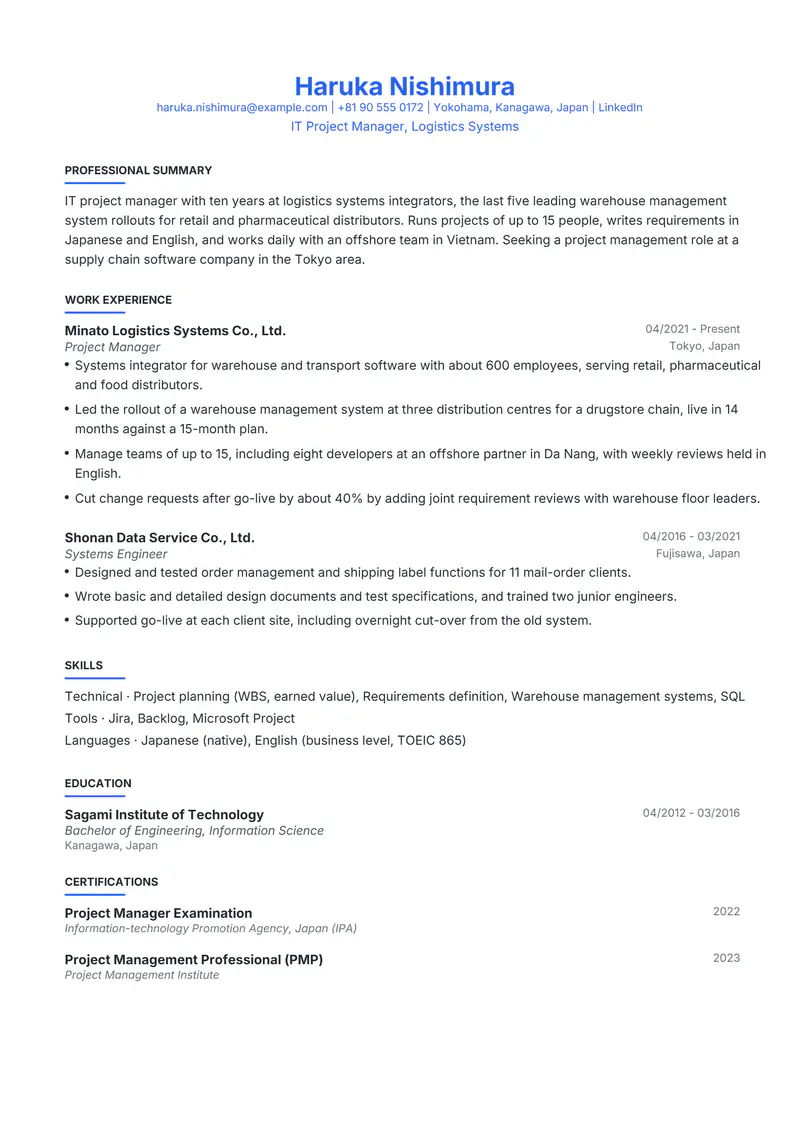
Japanese employers usually ask for two documents: the rirekisho, a fixed form with a photo box (Hello Work publishes the labour ministry's sample), and the shokumu keirekisho, a free-format career history of up to two A4 pages. Leslie suits the second, and an English resume for jobs advertised in English: summary, jobs, skills, qualifications. The fictional sample is a Yokohama IT project manager.
Download the Japan sample
Haruka is a fictional IT project manager. Replace every detail with your own before you send it.
The files are made in your browser by Resumity's own exporters, from this sample. The builder opens it as your own resume: click any line to replace it. Free plan, no watermark.
Why Leslie suits a Japan resume
Leslie prints a summary, then the jobs, then skills and education, close to the career history Hello Work Shinagawa lays out: a summary of knowledge and experience, the work history, then education and qualifications. Its one touch of blue in a centred header keeps the page formal, and it has no photo box, since the photo belongs on the rirekisho.
Second choice: Henrietta. Henrietta keeps the same summary-then-jobs order under a black and grey left-aligned header and lifts education up beside the work history.
What goes in each section, in Leslie's order
Leslie prints its sections in a fixed order, the same in the PDF and the Word file. Here is that order for this sample, and what to put in each section.
- Professional Summary. Hello Work Shinagawa's example opens with the job type you are applying for and a short summary of knowledge and experience, which it calls an important point when you have had several jobs. Two or three sentences: years, field, the scale of what you ran and what you want next.
- Work Experience. Open each employer with one line on what the company does and how big it is, the overview Shinagawa's preparation steps ask you to gather, then results with numbers: team size, schedule, share or time saved. The sample lists the newest job first, the order the guide recommends for foreign-affiliated firms.
- Skills. Methods, systems and tools, then languages with a test score. Shinagawa notes that employers read the career history partly as a test of computer skills, which is why it should be typed rather than handwritten.
- Education. Shinagawa says your final education is enough, with the graduation date. The sample gives one degree with April-to-March dates, the Japanese academic year, which also explains why the first job starts in April.
- Certifications. JASSO asks for licences and qualifications under their official names, including ones earned in your home country, and Shinagawa adds qualifications you are studying for. Leslie prints this list last, so mention a qualification the posting requires in the summary as well.
The sample resume as text
The same content as the files above, so you can copy a line or compare it with your own.
Haruka Nishimura
IT Project Manager, Logistics Systems
Yokohama, Kanagawa, Japan | haruka.nishimura@example.com | +81 90 555 0172 | linkedin.com/in/sample-haruka-nishimura
IT project manager with ten years at logistics systems integrators, the last five leading warehouse management system rollouts for retail and pharmaceutical distributors. Runs projects of up to 15 people, writes requirements in Japanese and English, and works daily with an offshore team in Vietnam. Seeking a project management role at a supply chain software company in the Tokyo area.
Experience
Project Manager, Minato Logistics Systems Co., Ltd., Tokyo, Japan (04/2021 to Present)
- Systems integrator for warehouse and transport software with about 600 employees, serving retail, pharmaceutical and food distributors.
- Led the rollout of a warehouse management system at three distribution centres for a drugstore chain, live in 14 months against a 15-month plan.
- Manage teams of up to 15, including eight developers at an offshore partner in Da Nang, with weekly reviews held in English.
- Cut change requests after go-live by about 40% by adding joint requirement reviews with warehouse floor leaders.
Systems Engineer, Shonan Data Service Co., Ltd., Fujisawa, Japan (04/2016 to 03/2021)
- Designed and tested order management and shipping label functions for 11 mail-order clients.
- Wrote basic and detailed design documents and test specifications, and trained two junior engineers.
- Supported go-live at each client site, including overnight cut-over from the old system.
Education
Bachelor of Engineering, Information Science, Sagami Institute of Technology (03/2016). Graduation research on routing algorithms for parcel delivery
Certifications
- Project Manager Examination, Information-technology Promotion Agency, Japan (IPA) (2022)
- Project Management Professional (PMP), Project Management Institute (2023)
Skills
Project planning (WBS, earned value), Requirements definition, Warehouse management systems, SQL, Jira, Backlog, Microsoft Project, Japanese (native), English (business level, TOEIC 865)
How to make the sample yours
Fill in the rirekisho on its own form
Resumity templates do not reproduce the rirekisho grid. Hello Work offers the labour ministry's sample form as Excel and PDF in A3 and A4; on it, the gender field is optional and the photo box is marked for use only where a photo is required.
Keep the photo for the rirekisho
JASSO tells applicants to use a photo taken in a suit at a studio and to write their name on the back in case it comes loose. That photo goes on the rirekisho; this template has no photo area, and you can add one to the DOCX in Word if an employer wants it on the career history too.
Add the closing signature in Word
Hello Work Shinagawa's example ends with a line confirming the contents are correct, the date, and a handwritten signature with a seal. Resumity templates print no signature, so type that line into the DOCX in Word and sign or stamp after printing.
Stop at two A4 pages
Shinagawa calls two pages the limit and warns that three or more makes readers doubt your ability to summarise. Resumity prints on A4, the paper size the guide assumes, so the preview shows the real length.
Order jobs for the reader
Shinagawa says Japanese companies usually expect the work history oldest first, while foreign-affiliated and some large firms want to see what you can do now, so newest first suits them. Decide per application before you send.
Keywords to keep where they are true
Terms this kind of resume is usually searched for. Use the posting's exact wording, and only for work you have done.
- project management
- requirements definition
- warehouse management system
- system rollout
- offshore development
- cut-over planning
- basic design
- detailed design
- test specifications
- change control
- vendor management
- PMP
- TOEIC
Mistakes to avoid
- Sending an English resume alone when the posting asks for a rirekisho and a shokumu keirekisho. Hello Work treats them as separate documents, and the career history adds detail to the form rather than replacing it.
- A third page. Hello Work Shinagawa says it makes the reader question how well you can summarise.
- Shortened or informal names for qualifications, where JASSO asks for the formal titles.
- A list of duties at each employer with no figure attached; Shinagawa's keyword sheet pushes numbers such as team size, share, sales and time saved.
How the sample PDF reads in text extractors
We exported this sample with Resumity's PDF exporter in Chrome on 2026-10-29 and read the file back with three open-source text extractors. This shows whether software that turns a PDF into text can recover it; it is not a test of any commercial applicant tracking system. How we test templates.
| Extractor | Name, email, phone | Headings | Bullets intact |
|---|---|---|---|
| pdf.js 4.10.38 | All found | 5 of 5 | 7 of 7 |
| pdftotext (Xpdf) 4.00 | All found | 5 of 5 | 7 of 7 |
| pypdf 6.13.0 | All found | 5 of 5 | 7 of 7 |
Frequently asked questions
What is the difference between a rirekisho and a shokumu keirekisho?
The rirekisho is a standard form: name, date of birth, address, education and work history, qualifications and motivation, usually with a photo. The shokumu keirekisho describes the work history in detail, in a free layout of up to two A4 pages. Hello Work Shinagawa describes it as the rirekisho's job history column written out in full.
Do Japanese employers still want a handwritten resume?
Less often. JASSO's 2027 guide says handwritten resumes used to be required but more and more companies now take them online. If you do handwrite one, it asks for a draft first, no correction fluid and no erasable pen. Hello Work Shinagawa says the career history should be typed.
Do I need a photo for a job application in Japan?
On the rirekisho, usually. JASSO recommends a studio photo in a suit, and the labour ministry's sample form keeps a photo box for employers that require one. Resumity templates print no photo, so the career history has none unless you add it to the DOCX in Word.
Do I have to state my gender on the rirekisho?
No. The labour ministry's sample rirekisho marks the gender field as optional and says it may be left blank. Hello Work introduced that form to support fair recruitment after the old JIS sample was withdrawn in 2020.
How long should a Japanese career history be?
Two A4 pages at most. Hello Work Shinagawa calls two pages the limit and says that the point is to summarise concisely and keep the layout easy to read.
Will applicant tracking systems read this Leslie PDF?
The sample PDF read back with its contact details, all 5 section headings and all 7 bullets intact in three open-source text extractors (pdf.js, pdftotext and pypdf). Commercial systems such as Workday, Greenhouse or Taleo were not tested, and each employer configures its own.
Guides and templates for this resume
- Want a Job Abroad? This International Resume Format Actually Works (2026 Guide)
- Resume template for an international job application
- No photo resume template for the US, UK and Canada
- CV vs resume
- How to List Languages and Proficiency Levels on a Resume
- Resume template for South Korea, under the fair hiring rules
- Resume template for China: a one-page jianli that leads with work
Sources, checked 29 October 2026
We opened every page below on that date. Pay, rules and requirements change, so check the source before you rely on a detail.
- Hello Work Internet Service (Ministry of Health, Labour and Welfare): Rirekisho and shokumu keirekisho: how to write them (career_doc01) (Employers generally ask for a rirekisho, and increasingly also a shokumu keirekisho; the ministry created its own sample rirekisho form for fair recruitment after the Japanese Standards Association removed the JIS sample in July 2020; the form is offered as PDF and Excel in A3 and A4.)
- Ministry of Health, Labour and Welfare (via Hello Work): MHLW sample rirekisho form (A4) (Fields: date, name with furigana, gender (marked optional, may be left blank), date of birth and age, address and contact, education and work history, licences and qualifications, motivation, special skills and appeal points, personal requests; a photo box for cases where a photo must be attached.)
- Hello Work Shinagawa (Tokyo Labour Bureau, Ministry of Health, Labour and Welfare): How to write a shokumu keirekisho (career history) (Two A4 pages is the limit, three or more raises doubts about your ability to summarise; type it on a computer, as computer skills are judged; chronological or career-based styles; gather each company's overview (business, capital or sales, employees); express results with numbers; layout: desired job, summary of knowledge and experience, work history (Japanese companies oldest first, foreign-affiliated and some large firms newest first), final education with graduation year, qualifications including planned ones, other details, closing confirmation with date, handwritten signature and seal.)
- Japan Student Services Organization (JASSO): Job Hunting Guide for International Students 2027 (Selection starts with an entry sheet and resume; handwritten resumes used to be required but online submission is increasingly common; polite desu-masu style; photo in a suit taken at a studio, name written on the back; official names of licences and qualifications, including those from your home country; no correction fluid or erasable pens on handwritten forms.)
More in resume and CV templates by country.