Resume template · Updated October 2026
Research CV template in a resume-style layout
Short answer
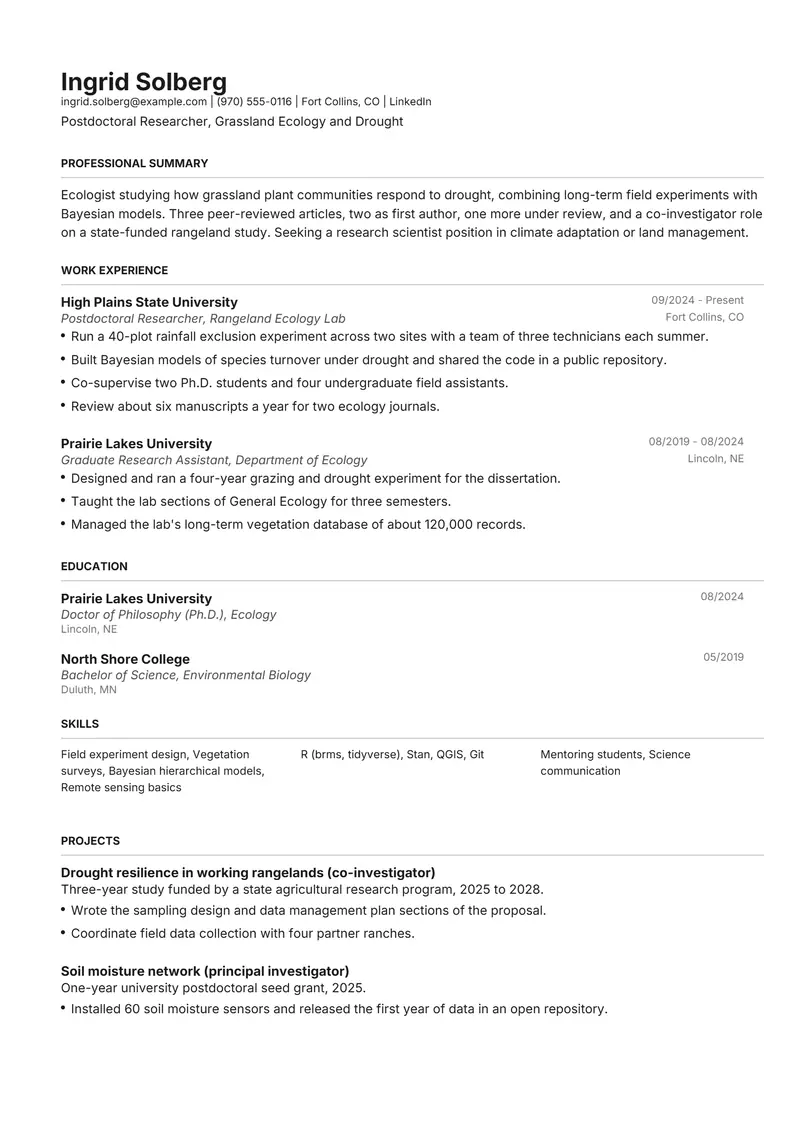
Henrietta is the closest Resumity layout to a research CV: it prints positions, then degrees, then skills and funded projects, ending with one titled list for publications and talks. Know the trade-off: Resumity templates are resume layouts, so the result is a resume-style CV, not a full academic CV with a heading for every category. The fictional sample is an ecology postdoc applying for research scientist posts.
Download the research CV sample
Ingrid is a fictional postdoctoral researcher. Replace every detail with your own before you send it.
The files are made in your browser by Resumity's own exporters, from this sample. The builder opens it as your own resume: click any line to replace it. Free plan, no watermark.
Why Henrietta suits a research CV resume
Henrietta prints education immediately after experience, so the postdoc, the Ph.D. and the dissertation title sit together near the top, and its conventional black and grey style suits a scholarly document. Funded research fits under Projects, and the publication list prints last as one titled section.
Second choice: FAANGPath. FAANGPath prints skills and projects before education; choose it for computational researchers heading to industry labs, where methods and code are read first.
What goes in each section, in Henrietta's order
Henrietta prints its sections in a fixed order, the same in the PDF and the Word file. Here is that order for this sample, and what to put in each section.
- Professional Summary. Two sentences naming your field, your research program in plain words and the kind of post you want. Academic CVs often have no summary, so keep it short, or leave it out if the call asks for a standard CV.
- Work Experience. Research appointments newest first: postdoc, then graduate research, each with the lab or institute. Teaching, student supervision and journal reviewing go as bullets here, since the layout has only one extra list.
- Education. Ph.D. with the dissertation title and advisor in the detail line, then earlier degrees. Academic readers often look for the advisor's name, so include it.
- Skills. Field and lab methods, statistical approaches and software. Henrietta shows them in a grid without labels, so put the methods your target lab uses first.
- Projects. Funded research goes here: project title, funder, your role (principal investigator, co-investigator, contributor), the years and the output. In a resume-style CV, this is where grants live.
- Publications and presentations. Every publication and talk goes in this one titled list, in your field's citation style, newest first, with your name in each entry. A long list makes the CV run to several pages, which is normal; label works under review as such.
The sample resume as text
The same content as the files above, so you can copy a line or compare it with your own.
Ingrid Solberg
Postdoctoral Researcher, Grassland Ecology and Drought
Fort Collins, CO | ingrid.solberg@example.com | (970) 555-0116 | linkedin.com/in/sample-ingrid-solberg
Ecologist studying how grassland plant communities respond to drought, combining long-term field experiments with Bayesian models. Three peer-reviewed articles, two as first author, one more under review, and a co-investigator role on a state-funded rangeland study. Seeking a research scientist position in climate adaptation or land management.
Experience
Postdoctoral Researcher, Rangeland Ecology Lab, High Plains State University, Fort Collins, CO (09/2024 to Present)
- Run a 40-plot rainfall exclusion experiment across two sites with a team of three technicians each summer.
- Built Bayesian models of species turnover under drought and shared the code in a public repository.
- Co-supervise two Ph.D. students and four undergraduate field assistants.
- Review about six manuscripts a year for two ecology journals.
Graduate Research Assistant, Department of Ecology, Prairie Lakes University, Lincoln, NE (08/2019 to 08/2024)
- Designed and ran a four-year grazing and drought experiment for the dissertation.
- Taught the lab sections of General Ecology for three semesters.
- Managed the lab's long-term vegetation database of about 120,000 records.
Projects
Drought resilience in working rangelands (co-investigator): Three-year study funded by a state agricultural research program, 2025 to 2028.
- Wrote the sampling design and data management plan sections of the proposal.
- Coordinate field data collection with four partner ranches.
Soil moisture network (principal investigator): One-year university postdoctoral seed grant, 2025.
- Installed 60 soil moisture sensors and released the first year of data in an open repository.
Publications and presentations
- Solberg, I., Ortega, P., Lindgren, M. (2026). Drought legacies in mixed-grass prairie. Plains Ecology Letters 14:211-224.
- Solberg, I., Lindgren, M. (2025). Grazing history and species turnover under drought. Rangeland Systems Review 9:88-101.
- Ortega, P., Solberg, I., Chen, R. (2024). Soil moisture thresholds for grass recovery. Plains Ecology Letters 12:45-57.
- Solberg, I., Lindgren, M. (under review). Bayesian models of community change in rainfall experiments.
- Invited talk: "Drought and grazing: what a decade of plots shows." Regional rangeland society meeting, 2026.
- Contributed talk, national ecology society meeting, 2024.
Education
Doctor of Philosophy (Ph.D.), Ecology, Prairie Lakes University (08/2024). Dissertation: Grazing history and drought resistance in mixed-grass prairie. Advisor: Prof. M. Lindgren
Bachelor of Science, Environmental Biology, North Shore College (05/2019)
Skills
Field experiment design, Vegetation surveys, Bayesian hierarchical models, Remote sensing basics, R (brms, tidyverse), Stan, QGIS, Git, Mentoring students, Science communication
How to make the sample yours
Check that a resume-style CV is acceptable
For research scientist, staff scientist and many institute posts, this format works. If a faculty search asks for a full academic CV with separate sections for grants, teaching, service and mentoring, a resume template will not reproduce that structure.
Trim the list before it swamps the page
The sample keeps publications and talks together. With dozens of items, keep peer-reviewed articles and invited talks here and link a full list from the header.
State your role on every grant
Write principal investigator, co-investigator or contributor honestly and give the funder's full name. List amounts only for awards you held or managed.
Label the status of every item
Published, in press, under review, in preparation: committees read these labels closely. Keep "in preparation" items to a few, or leave them off.
Fit mentoring and service into bullets
Students you supervised, peer review and committee work go as bullets under the relevant position, as the sample does under the postdoc.
Keywords to keep where they are true
Terms this kind of resume is usually searched for. Use the posting's exact wording, and only for work you have done.
- research CV
- postdoctoral researcher
- peer-reviewed publications
- grant funding
- co-investigator
- field experiments
- Bayesian statistics
- R
- data management
- mentoring
- conference presentations
- peer review
- teaching
Mistakes to avoid
- Expecting a resume template to give you separate headings for grants, teaching, service and mentoring. Use Projects, bullets under your positions and the one titled list.
- Padding the publication list with conference abstracts formatted to look like articles.
- Listing a grant you helped write as if you were the principal investigator.
- Leaving out works under review. List them with that status; they show work in progress.
How the sample PDF reads in text extractors
We exported this sample with Resumity's PDF exporter in Chrome on 2026-10-29 and read the file back with three open-source text extractors. This shows whether software that turns a PDF into text can recover it; it is not a test of any commercial applicant tracking system. How we test templates.
| Extractor | Name, email, phone | Headings | Bullets intact |
|---|---|---|---|
| pdf.js 4.10.38 | All found | 6 of 6 | 10 of 10 |
| pdftotext (Xpdf) 4.00 | All found | 6 of 6 | 10 of 10 |
| pypdf 6.13.0 | All found | 6 of 6 | 10 of 10 |
Frequently asked questions
What is the difference between a research CV and a resume?
A research CV records your whole academic output (positions, degrees, funding, publications, talks, teaching) and can run several pages. A resume is a short, selected summary for one job. This sample is a resume-style CV: complete lists in a compact layout.
Can a research CV be longer than two pages?
Yes. Length follows your record. Make sure the first page carries your positions, degrees and most important funding, and let the publication list run.
Where do grants go in this layout?
Under Projects, one entry per funded project, with the funder, your role, the years and the output.
How should I list publications under review?
Write "under review" where the year would go, and update the entry with the journal and year once it is accepted.
Should a research CV include teaching?
Yes, briefly. Here, teaching goes as bullets or its own entry under experience; for a teaching-focused post, the teaching CV page in this series fits better.
Will applicant tracking systems read this Henrietta PDF?
The sample PDF read back with its contact details, all 6 section headings and all 10 bullets intact in three open-source text extractors (pdf.js, pdftotext and pypdf). Commercial systems such as Workday, Greenhouse or Taleo were not tested, and each employer configures its own.
Guides and templates for this resume
More in resume templates by education.