Resume template · Updated October 2026
Academic researcher resume template
Short answer
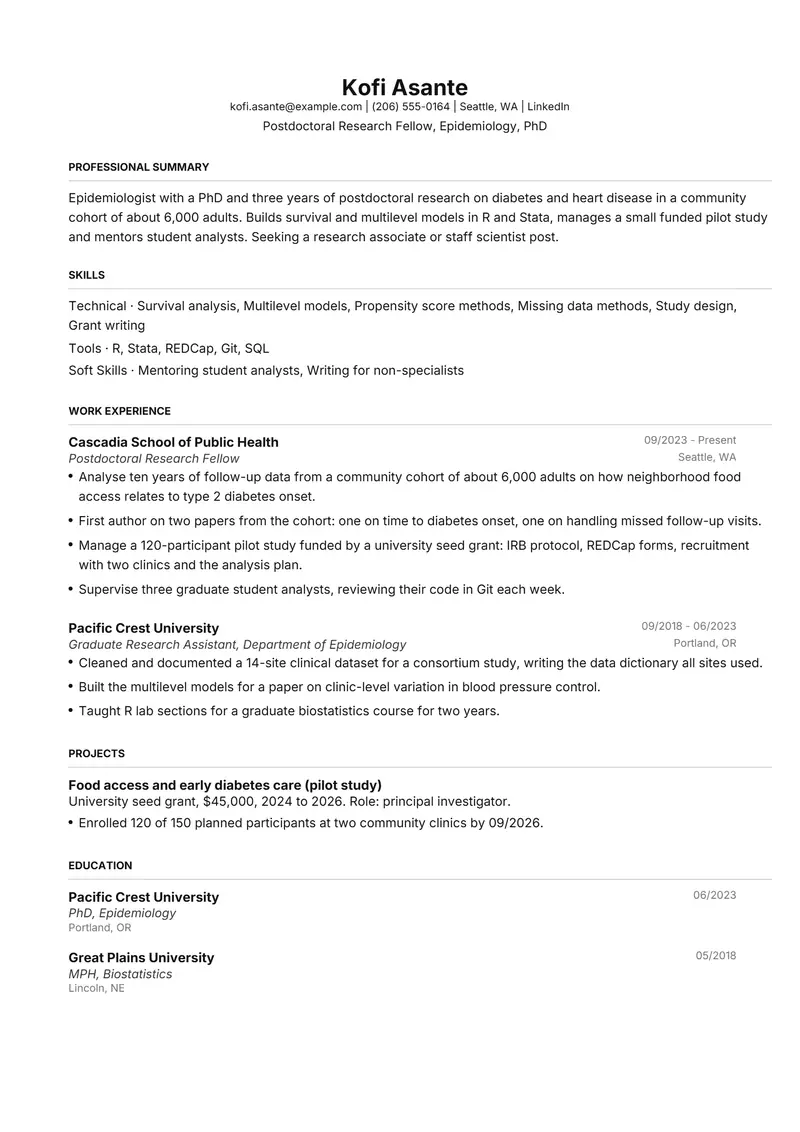
FAANGPath works for an academic researcher who needs a short resume instead of a full CV, for example for a research associate, research center or staff scientist post. It prints skills before experience, so methods and software are read first. The fictional sample is an epidemiology postdoc who models cohort data in R and Stata, runs a small funded pilot study and ends with three selected papers.
Download the academic researcher sample
Kofi is a fictional postdoctoral research fellow. Replace every detail with your own before you send it.
The files are made in your browser by Resumity's own exporters, from this sample. The builder opens it as your own resume: click any line to replace it. Free plan, no watermark.
Why FAANGPath suits an academic researcher resume
FAANGPath puts a labelled skills block above the job history in a minimal centred layout, so a principal investigator scanning for survival models, R or REDCap finds them in the first third of the page. Its black-and-grey style matches the plain documents research committees read, and the labelled rows keep methods apart from software.
Second choice: Henrietta. Henrietta prints education right after experience; choose it when a recent doctorate from a known program is your strongest point.
What goes in each section, in FAANGPath's order
FAANGPath prints its sections in a fixed order, the same in the PDF and the Word file. Here is that order for this sample, and what to put in each section.
- Professional Summary. Field, career stage and research focus in one sentence, then methods and the data you work with (cohorts, trials, surveys, health records). End with the post you want: research associate, staff scientist, research program manager.
- Skills. The two rows that matter most are methods (survival analysis, multilevel models, causal inference, qualitative coding) and software (R, Stata, SAS, Python, REDCap, NVivo). Research administration (IRB protocols, data use agreements, budgets) earns a place if you have done it.
- Work Experience. Treat the postdoc and the PhD as jobs. Each bullet says what you studied, with what data, what came out (a paper, a dataset, a tool) and what you ran. First-author papers can be named inside the bullet they came from.
- Projects. Funded studies you led or co-led: a plain-language title, funder type, amount if you held the award, dates and your role. Two or three at most.
- Education. PhD with field, institution and year, with the dissertation title as a detail if it matches the post. Master's and bachelor's follow.
- Selected publications. "Selected publications": three to five items in your field's citation style, with your name where it falls in the author list. Point to the complete record (ORCID or a faculty page) in the header.
The sample resume as text
The same content as the files above, so you can copy a line or compare it with your own.
Kofi Asante
Postdoctoral Research Fellow, Epidemiology, PhD
Seattle, WA | kofi.asante@example.com | (206) 555-0164 | linkedin.com/in/sample-kofi-asante
Epidemiologist with a PhD and three years of postdoctoral research on diabetes and heart disease in a community cohort of about 6,000 adults. Builds survival and multilevel models in R and Stata, manages a small funded pilot study and mentors student analysts. Seeking a research associate or staff scientist post.
Experience
Postdoctoral Research Fellow, Cascadia School of Public Health, Seattle, WA (09/2023 to Present)
- Analyse ten years of follow-up data from a community cohort of about 6,000 adults on how neighborhood food access relates to type 2 diabetes onset.
- First author on two papers from the cohort: one on time to diabetes onset, one on handling missed follow-up visits.
- Manage a 120-participant pilot study funded by a university seed grant: IRB protocol, REDCap forms, recruitment with two clinics and the analysis plan.
- Supervise three graduate student analysts, reviewing their code in Git each week.
Graduate Research Assistant, Department of Epidemiology, Pacific Crest University, Portland, OR (09/2018 to 06/2023)
- Cleaned and documented a 14-site clinical dataset for a consortium study, writing the data dictionary all sites used.
- Built the multilevel models for a paper on clinic-level variation in blood pressure control.
- Taught R lab sections for a graduate biostatistics course for two years.
Projects
Food access and early diabetes care (pilot study): University seed grant, $45,000, 2024 to 2026. Role: principal investigator.
- Enrolled 120 of 150 planned participants at two community clinics by 09/2026.
Selected publications
- Asante K, Rowe M, Lindgren P. Neighborhood food access and incident type 2 diabetes in a community cohort. Cascade Journal of Population Health. 2025.
- Asante K, Rowe M. Handling missed follow-up visits in a ten-year cohort. Methods in Cohort Research. 2024.
- Vargas L, Asante K, Tran H. Clinic-level variation in blood pressure control. Northwest Primary Care Review. 2023.
Education
PhD, Epidemiology, Pacific Crest University (06/2023). Dissertation: neighborhood context and blood pressure control in primary care
MPH, Biostatistics, Great Plains University (05/2018)
Skills
Survival analysis, Multilevel models, Propensity score methods, Missing data methods, Study design, Grant writing, R, Stata, REDCap, Git, SQL, Mentoring student analysts, Writing for non-specialists
How to make the sample yours
Link a persistent research profile
Add your ORCID iD or faculty page to the header links. ORCID iDs are free, persistent identifiers for researchers, and they keep the full publication list one click away without lengthening the resume.
End each bullet with what the finding fed
A research center wants methods and data; a government or nonprofit team also wants to know what the work informed. Add the use where you know it: a guideline, a program, a follow-up grant.
State your funding role exactly
Principal investigator, co-investigator and "wrote the analysis plan" are different claims. Write the one that matches the award record.
Count the people you supervised
Student analysts, research assistants and coordinators you managed are evidence for staff scientist and program manager roles. Give the number and what you reviewed.
Cut teaching unless the post asks for it
One line on courses or lab sections you taught is enough here; the detail stays on the CV.
Keywords to keep where they are true
Terms this kind of resume is usually searched for. Use the posting's exact wording, and only for work you have done.
- epidemiology
- cohort study
- survival analysis
- multilevel modeling
- causal inference
- R
- Stata
- REDCap
- IRB protocol
- grant writing
- peer-reviewed publications
- data management
- reproducible analysis
- research mentoring
Mistakes to avoid
- Sending a twelve-page CV when the posting asks for a resume; condense to two pages and link the full record.
- Listing every statistical method you have read about; keep the ones you have published with or could run tomorrow.
- Hiding author position, so a reader cannot tell a first-author paper from a consortium paper.
- Describing participants or datasets in ways a data use agreement does not allow.
How the sample PDF reads in text extractors
We exported this sample with Resumity's PDF exporter in Chrome on 2026-10-29 and read the file back with three open-source text extractors. This shows whether software that turns a PDF into text can recover it; it is not a test of any commercial applicant tracking system. How we test templates.
| Extractor | Name, email, phone | Headings | Bullets intact |
|---|---|---|---|
| pdf.js 4.10.38 | All found | 6 of 6 | 8 of 8 |
| pdftotext (Xpdf) 4.00 | All found | 6 of 6 | 8 of 8 |
| pypdf 6.13.0 | All found | 6 of 6 | 8 of 8 |
Frequently asked questions
Should an academic researcher use a resume or a CV?
Use what the posting asks for. Faculty and fellowship applications usually want the full CV; research associate, staff scientist, government and nonprofit research posts often accept a two-page resume like this one.
How do I list publications on a research resume?
Pick three to five that match the post, in your field's citation style, with the author order as published. Add a link to the complete list on your ORCID record or faculty page.
How do I put a postdoc on a resume?
As a job, with title, institution, dates and bullets. Name the project and its data, then what you produced and what you led, rather than "conducted research".
Should I include grants I helped write but did not lead?
Yes, with your exact role: "wrote the analysis plan for a federal grant application, funded 2024". Keep principal investigator and co-investigator titles for awards where you are listed in that role.
How long should an academic researcher resume be?
Two pages for most postdocs and research staff. Methods, two research jobs, one or two funded projects and a short publication list fit within that.
Will applicant tracking systems read this FAANGPath PDF?
The sample PDF read back with its contact details, all 6 section headings and all 8 bullets intact in three open-source text extractors (pdf.js, pdftotext and pypdf). Commercial systems such as Workday, Greenhouse or Taleo were not tested, and each employer configures its own.
Guides and templates for this resume
Sources, checked 29 October 2026
We opened every page below on that date. Pay, rules and requirements change, so check the source before you rely on a detail.
- ORCID: What is ORCID? (an ORCID iD is a unique, persistent identifier, free of charge to researchers)
More in resume templates by job title.