Resume template · Updated October 2026
Clinical data manager resume template
Short answer
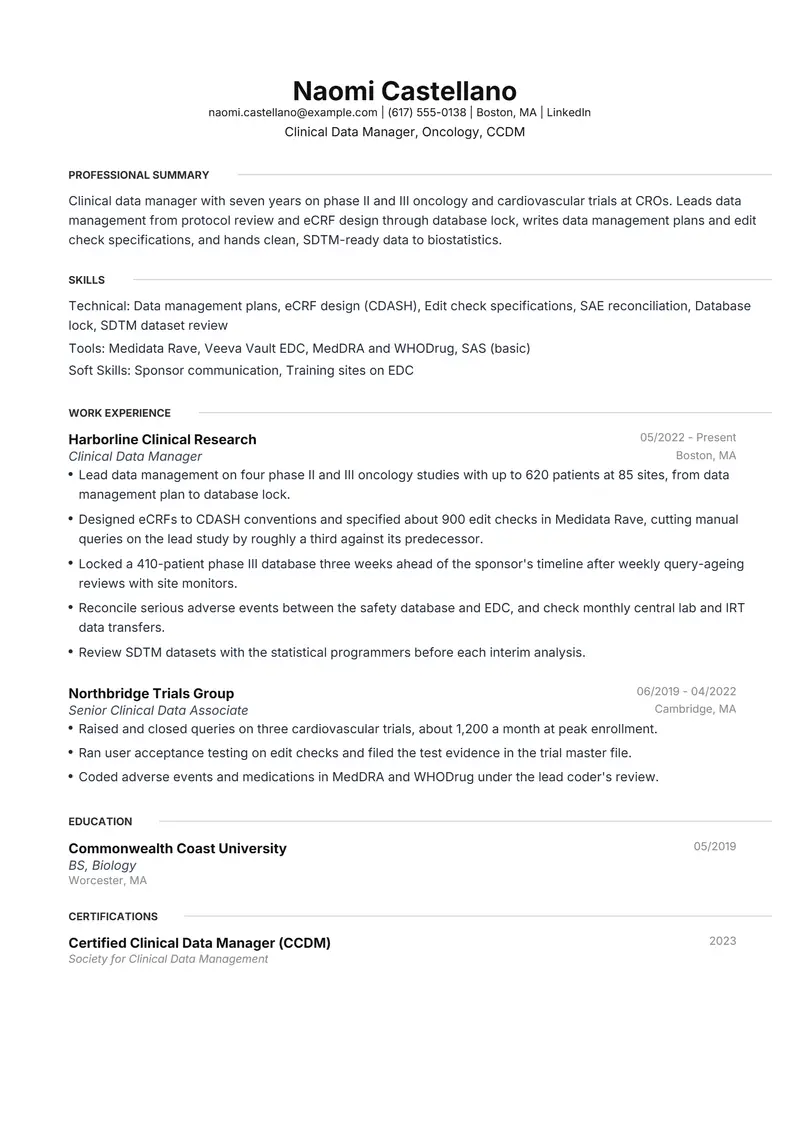
Meridian suits a clinical data manager: a short summary, then labelled skill rows for EDC systems, coding dictionaries and data standards, then the trials themselves. Sponsors and CROs screen for those systems first. The fictional sample leads data management on phase II and III oncology studies at a Boston CRO, from data management plan to database lock, after three years raising queries as a clinical data associate. She holds the CCDM.
Download the clinical data manager sample
Naomi is a fictional clinical data manager. Replace every detail with your own before you send it.
The files are made in your browser by Resumity's own exporters, from this sample. The builder opens it as your own resume: click any line to replace it. Free plan, no watermark.
Why Meridian suits a clinical data manager resume
Meridian prints summary, skills, work experience, education and certifications in that order, so the EDC platforms, dictionaries and CDISC work a hiring manager filters on are read before the studies. Its labelled rows keep Medidata Rave and SAS apart from tasks like edit check design, and the plain grey layout suits a regulated, document-heavy field.
Second choice: Catalyst. Catalyst opens on your latest study and skips the summary; better for a lead or associate director whose recent trials carry the case.
What goes in each section, in Meridian's order
Meridian prints its sections in a fixed order, the same in the PDF and the Word file. Here is that order for this sample, and what to put in each section.
- Professional Summary. Phases and therapeutic areas, sponsor or CRO side, years, and the span of the study you own (setup, conduct, lock). Name the CCDM here too, since certifications print at the bottom.
- Skills. Technical for the work itself (data management plans, eCRF design, edit check specifications, reconciliation, lock); Tools for EDC platforms, coding dictionaries and any SAS or R; Soft Skills for sponsor communication and site training.
- Work Experience. For each study: phase, indication, patients and sites, and your role in it. Then the milestones a sponsor pays for: database builds on time, query ageing, reconciliation, interim and final locks. A lock date beaten or a query load cut is worth a bullet.
- Education. A life sciences, health informatics or nursing degree with the year. A clinical research certificate can follow on its own line.
- Certifications. CCDM from the Society for Clinical Data Management with its year, plus GCP training if a posting asks for it.
The sample resume as text
The same content as the files above, so you can copy a line or compare it with your own.
Naomi Castellano
Clinical Data Manager, Oncology, CCDM
Boston, MA | naomi.castellano@example.com | (617) 555-0138 | linkedin.com/in/sample-naomi-castellano
Clinical data manager with seven years on phase II and III oncology and cardiovascular trials at CROs. Leads data management from protocol review and eCRF design through database lock, writes data management plans and edit check specifications, and hands clean, SDTM-ready data to biostatistics.
Experience
Clinical Data Manager, Harborline Clinical Research, Boston, MA (05/2022 to Present)
- Lead data management on four phase II and III oncology studies with up to 620 patients at 85 sites, from data management plan to database lock.
- Designed eCRFs to CDASH conventions and specified about 900 edit checks in Medidata Rave, cutting manual queries on the lead study by roughly a third against its predecessor.
- Locked a 410-patient phase III database three weeks ahead of the sponsor's timeline after weekly query-ageing reviews with site monitors.
- Reconcile serious adverse events between the safety database and EDC, and check monthly central lab and IRT data transfers.
- Review SDTM datasets with the statistical programmers before each interim analysis.
Senior Clinical Data Associate, Northbridge Trials Group, Cambridge, MA (06/2019 to 04/2022)
- Raised and closed queries on three cardiovascular trials, about 1,200 a month at peak enrollment.
- Ran user acceptance testing on edit checks and filed the test evidence in the trial master file.
- Coded adverse events and medications in MedDRA and WHODrug under the lead coder's review.
Education
BS, Biology, Commonwealth Coast University (05/2019)
Certifications
- Certified Clinical Data Manager (CCDM), Society for Clinical Data Management (2023)
Skills
Data management plans, eCRF design (CDASH), Edit check specifications, SAE reconciliation, Database lock, SDTM dataset review, Medidata Rave, Veeva Vault EDC, MedDRA and WHODrug, SAS (basic), Sponsor communication, Training sites on EDC
How to make the sample yours
Size each study
Phase, indication, patient count, sites, countries. A 40-patient phase I and a 900-patient global phase III are different jobs, and the reader wants to know which you have handled.
Separate building from using
Say whether you built the study database, wrote the edit check specifications or worked inside a database someone else built. Postings for study builders and for data managers screen for different things.
Show the lock
Database lock is the milestone sponsors remember. Give the date against plan, the outstanding query count at lock or the number of locks you led.
Name your data standards
CDASH for collection, SDTM for submission, MedDRA and WHODrug for coding. Add which you designed for, mapped or only reviewed.
Match the sponsor or CRO side
CRO roles reward juggling several sponsors and timelines; sponsor roles reward vendor oversight and cross-study consistency. Tilt the summary toward the side you are applying to.
Keywords to keep where they are true
Terms this kind of resume is usually searched for. Use the posting's exact wording, and only for work you have done.
- clinical data management
- data management plan
- eCRF design
- edit checks
- EDC
- Medidata Rave
- database lock
- query management
- SAE reconciliation
- CDISC
- SDTM
- CDASH
- MedDRA
- GCP
- user acceptance testing
Mistakes to avoid
- A list of trials with no phase, indication, patient count or role.
- Claiming SDTM programming when you reviewed datasets that programmers built.
- Leaving out database lock, the result every hiring manager looks for.
- Naming the sponsor or drug of a confidential study; describe it by phase and indication instead.
How the sample PDF reads in text extractors
We exported this sample with Resumity's PDF exporter in Chrome on 2026-10-29 and read the file back with three open-source text extractors. This shows whether software that turns a PDF into text can recover it; it is not a test of any commercial applicant tracking system. How we test templates.
| Extractor | Name, email, phone | Headings | Bullets intact |
|---|---|---|---|
| pdf.js 4.10.38 | All found | 5 of 5 | 8 of 8 |
| pdftotext (Xpdf) 4.00 | All found | 5 of 5 | 8 of 8 |
| pypdf 6.13.0 | All found | 5 of 5 | 8 of 8 |
Frequently asked questions
When can I take the CCDM exam, and is it worth listing?
SCDM's eligibility rules ask for a bachelor's degree and two or more years of full-time clinical data management experience, an associate degree and three years, or four years of experience on its own. SCDM notes that some job postings list the CCDM as preferred or required, so give it a line with the year once you pass.
Which EDC systems should I name?
Every system you have worked in, with a word on depth: built studies, wrote checks, or entered and cleaned data. A hiring manager filling a Rave study build will skip a resume that only says "EDC".
How do I show CDISC experience if I am not a programmer?
Say what you did with the standards: designed CRFs so they map cleanly, reviewed datasets, resolved mapping questions. CDISC lists SDTM among the required standards for data submission to FDA in the U.S. and PMDA in Japan, so sponsors value data managers who keep collection and submission in step.
How do I move into data management from a CRA or study coordinator job?
Lead with the data side of your current work: EDC entry, query resolution, source data verification, reconciliation. Add any data management course and aim first for clinical data associate roles.
Should I list therapeutic areas?
Yes, in the summary and inside each study bullet. Oncology, cardiovascular, vaccines and rare disease studies each have their own data quirks, and recruiters often search by area.
Will applicant tracking systems read this Meridian PDF?
The sample PDF read back with its contact details, all 5 section headings and all 8 bullets intact in three open-source text extractors (pdf.js, pdftotext and pypdf). Commercial systems such as Workday, Greenhouse or Taleo were not tested, and each employer configures its own.
Guides and templates for this resume
Sources, checked 29 October 2026
We opened every page below on that date. Pay, rules and requirements change, so check the source before you rely on a detail.
- Society for Clinical Data Management: CCDM Certification (eligibility: bachelor's degree or higher and 2+ years full-time CDM experience, associate degree and 3+ years, or 4+ years full-time CDM experience; job postings may specify CCDM preferred or required)
- CDISC: SDTM (SDTM is one of the required standards for data submission to FDA (U.S.) and PMDA (Japan))
More in resume templates by job title.