Resume template · Updated October 2026
Environmental scientist resume template
Short answer
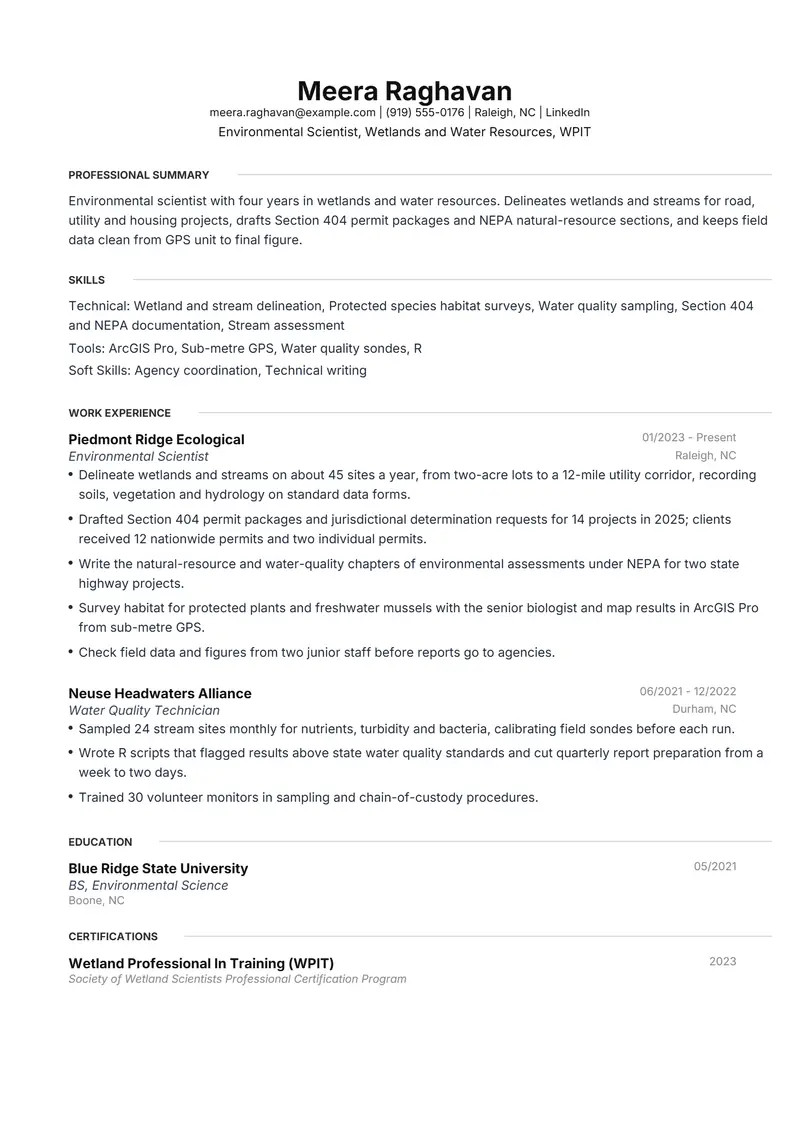
Meridian suits an environmental scientist: after a short summary it prints labelled skill rows for field methods and software, then the jobs, on a plain page with no colour. The fictional sample delineates wetlands and streams for an ecological consultancy in North Carolina and drafts permit and NEPA material, after eighteen months monitoring water quality for a watershed nonprofit. She holds the Wetland Professional In Training certification.
Download the environmental scientist sample
Meera is a fictional environmental scientist. Replace every detail with your own before you send it.
The files are made in your browser by Resumity's own exporters, from this sample. The builder opens it as your own resume: click any line to replace it. Free plan, no watermark.
Why Meridian suits an environmental scientist resume
Meridian runs summary, skills, work experience, education and certifications, so the field methods, GIS and statistics tools that environmental postings list are read before the employers. Its labelled rows (Technical, Tools, Soft Skills) keep sampling methods apart from software, and the grey rules with no colour print and photocopy cleanly for agency and consultancy interview panels.
Second choice: Leslie. Leslie puts work experience ahead of skills; better once you manage projects and the permits you delivered matter more than your methods.
What goes in each section, in Meridian's order
Meridian prints its sections in a fixed order, the same in the PDF and the Word file. Here is that order for this sample, and what to put in each section.
- Professional Summary. Your branch (wetlands, water quality, air, contaminated sites, EHS compliance), the employer type (consultancy, agency, utility, nonprofit), years, and the documents or decisions your work feeds. Name WPIT, PWS or another credential here, since certifications print last.
- Skills. Technical holds field and analytical methods (delineation, stream assessment, species surveys, water sampling); Tools holds ArcGIS Pro, GPS units, sondes and R or Python; Soft Skills can carry agency coordination and technical writing, both of which come up in interviews.
- Work Experience. Count sites, acres, samples or reports, and name what each fed into: a permit application, an environmental assessment, a monitoring report. Say what you wrote and what the agency decided, and keep the two apart.
- Education. Degree, school and year, with a coursework line if it covers wetland ecology, hydric soils, hydrology or statistics; certification panels count those credit hours.
- Certifications. WPIT or PWS from the Society of Wetland Scientists Professional Certification Program, HAZWOPER for contaminated-site work, and any state inspector credential, each with its year.
The sample resume as text
The same content as the files above, so you can copy a line or compare it with your own.
Meera Raghavan
Environmental Scientist, Wetlands and Water Resources, WPIT
Raleigh, NC | meera.raghavan@example.com | (919) 555-0176 | linkedin.com/in/sample-meera-raghavan
Environmental scientist with four years in wetlands and water resources. Delineates wetlands and streams for road, utility and housing projects, drafts Section 404 permit packages and NEPA natural-resource sections, and keeps field data clean from GPS unit to final figure.
Experience
Environmental Scientist, Piedmont Ridge Ecological, Raleigh, NC (01/2023 to Present)
- Delineate wetlands and streams on about 45 sites a year, from two-acre lots to a 12-mile utility corridor, recording soils, vegetation and hydrology on standard data forms.
- Drafted Section 404 permit packages and jurisdictional determination requests for 14 projects in 2025; clients received 12 nationwide permits and two individual permits.
- Write the natural-resource and water-quality chapters of environmental assessments under NEPA for two state highway projects.
- Survey habitat for protected plants and freshwater mussels with the senior biologist and map results in ArcGIS Pro from sub-metre GPS.
- Check field data and figures from two junior staff before reports go to agencies.
Water Quality Technician, Neuse Headwaters Alliance, Durham, NC (06/2021 to 12/2022)
- Sampled 24 stream sites monthly for nutrients, turbidity and bacteria, calibrating field sondes before each run.
- Wrote R scripts that flagged results above state water quality standards and cut quarterly report preparation from a week to two days.
- Trained 30 volunteer monitors in sampling and chain-of-custody procedures.
Education
BS, Environmental Science, Blue Ridge State University (05/2021). Coursework: wetland ecology, hydric soils, hydrology, plant taxonomy, GIS, statistics
Certifications
- Wetland Professional In Training (WPIT), Society of Wetland Scientists Professional Certification Program (2023)
Skills
Wetland and stream delineation, Protected species habitat surveys, Water quality sampling, Section 404 and NEPA documentation, Stream assessment, ArcGIS Pro, Sub-metre GPS, Water quality sondes, R, Agency coordination, Technical writing
How to make the sample yours
Pick one branch and lead with it
Wetlands, water quality, remediation, air permitting and EHS compliance hire on different evidence. Rewrite the summary and the Technical row for the branch in the posting instead of listing all five.
Put numbers on field seasons
Sites delineated, linear feet of stream assessed, samples collected, sondes maintained. Without counts, three field seasons read the same as one.
Name the documents you wrote
Jurisdictional determination requests, permit application sections, environmental assessment chapters, monitoring reports. Hiring managers want proof you can write for a regulator.
Show how you handle data
QA/QC on lab results, R or Python scripts, databases you kept, exceedances you flagged. Many postings now weigh this as heavily as fieldwork.
Match the employer
Agencies look for regulatory knowledge and public communication; consultancies for billable output and client deadlines; nonprofits for volunteer coordination and grants. Reorder the bullets inside each job to suit.
Keywords to keep where they are true
Terms this kind of resume is usually searched for. Use the posting's exact wording, and only for work you have done.
- environmental scientist
- wetland delineation
- stream assessment
- Section 404 permitting
- NEPA
- environmental assessment
- water quality sampling
- protected species surveys
- ArcGIS Pro
- GPS data collection
- R
- technical writing
- agency coordination
- field data QA/QC
Mistakes to avoid
- Saying you "obtained" a permit that the Corps or a state agency issued; say what you prepared.
- A long list of environmental laws you have read about and no field methods.
- Hiding your branch, so a contaminated-site manager and a wetlands manager both pass you over.
- Writing PWS before the five years of qualifying experience have been accepted.
How the sample PDF reads in text extractors
We exported this sample with Resumity's PDF exporter in Chrome on 2026-10-29 and read the file back with three open-source text extractors. This shows whether software that turns a PDF into text can recover it; it is not a test of any commercial applicant tracking system. How we test templates.
| Extractor | Name, email, phone | Headings | Bullets intact |
|---|---|---|---|
| pdf.js 4.10.38 | All found | 5 of 5 | 8 of 8 |
| pdftotext (Xpdf) 4.00 | All found | 5 of 5 | 8 of 8 |
| pypdf 6.13.0 | All found | 5 of 5 | 8 of 8 |
Frequently asked questions
Should I list WPIT or wait until I have PWS?
List WPIT with its year. The Society of Wetland Scientists Professional Certification Program describes WPIT as a preliminary step for people who meet the education requirements but not yet the experience or specialized coursework, while PWS needs at least five years of full-time professional experience gained within the ten years before applying, plus 15 semester hours of specialized wetland coursework.
How do I describe permit work without overstating my role?
Say what you prepared and who decided. EPA describes the U.S. Army Corps of Engineers as running the day-to-day Section 404 program, including individual and general permit decisions, with approved state or tribal programs in some places. "Drafted 14 permit packages; clients received 12 nationwide permits" is accurate and still strong.
Is NEPA experience worth listing?
Yes, if you wrote or reviewed part of an environmental assessment or impact statement. EPA explains that NEPA requires federal agencies to weigh the environmental effects of proposed actions, such as permit decisions and highway projects, before deciding. Name the document type and the chapters you wrote.
How is an environmental scientist resume different from an environmental engineer resume?
Scientists lead with field methods, sampling, data and regulatory writing; engineers lead with design, calculations and licensure. If you do both, title the resume for the posting and keep the other side to a few bullets.
Do government environmental jobs need a different resume?
State and local agencies usually accept a resume like this one. Federal postings ask for much more detail under each job, so read the federal resume guide before applying through USAJOBS.
Should I include student or volunteer fieldwork?
Early on, yes: thesis fieldwork, a watershed group or a summer field crew, with sample counts. Cut them as paid work replaces them.
Will applicant tracking systems read this Meridian PDF?
The sample PDF read back with its contact details, all 5 section headings and all 8 bullets intact in three open-source text extractors (pdf.js, pdftotext and pypdf). Commercial systems such as Workday, Greenhouse or Taleo were not tested, and each employer configures its own.
Guides and templates for this resume
Sources, checked 29 October 2026
We opened every page below on that date. Pay, rules and requirements change, so check the source before you rely on a detail.
- Society of Wetland Scientists Professional Certification Program: Requirements (WPIT is a preliminary step for those who meet the basic education requirements but not the experience or specialized wetland coursework; PWS requires at least five years of full-time professional experience gained within the ten years before applying, plus 15 semester hours of specialized wetland course work)
- U.S. Environmental Protection Agency: Permit Program under CWA Section 404 (Section 404 regulates discharge of dredged or fill material into waters of the United States, including wetlands; the Corps administers the day-to-day program, including individual and general permit decisions; approved state or tribal 404(g) programs review in some places)
- U.S. Environmental Protection Agency: What is the National Environmental Policy Act? (NEPA requires federal agencies to assess the environmental effects of proposed actions before deciding, including permit applications and highway construction; documents are Environmental Assessments and Environmental Impact Statements)
More in resume templates by job title.