Resume template · Updated October 2026
Farmer resume template
Short answer
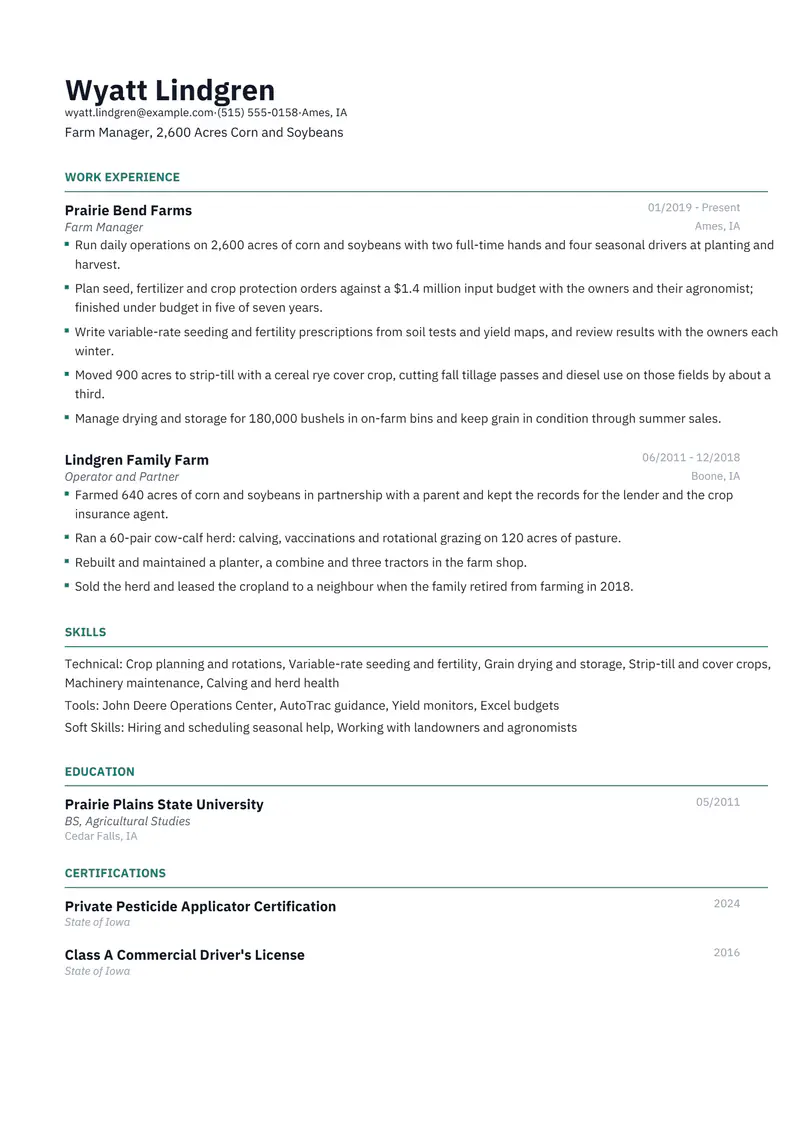
Catalyst suits a farmer applying to run or work on a larger operation: it skips the summary and opens on your current job, with acres, crops and crew right under your name. The fictional sample manages 2,600 acres of corn and soybeans in central Iowa for a landowner family, after eight years farming in partnership with a parent and running a small cow-calf herd. His headline states the scale in one line.
Download the farmer sample
Wyatt is a fictional farm manager. Replace every detail with your own before you send it.
The files are made in your browser by Resumity's own exporters, from this sample. The builder opens it as your own resume: click any line to replace it. Free plan, no watermark.
Why Catalyst suits a farmer resume
Catalyst prints no summary and opens on work experience, so the operation you run now (acres, crops, livestock, crew, budget) is the first thing a landowner or farm management company reads. The large left-aligned name with the job title beneath it works as a headline for the scale, and the labelled skill rows keep machinery apart from agronomy.
Second choice: Leslie. Leslie keeps a short summary ahead of the jobs; better when you are leaving farming for co-op, agronomy sales or equipment dealer work and need to explain the move.
What goes in each section, in Catalyst's order
Catalyst prints its sections in a fixed order, the same in the PDF and the Word file. Here is that order for this sample, and what to put in each section.
- Work Experience. One entry per operation with acres, crops or livestock, the people you supervise and the money you handle. A family farm is a real employer: give it a title (operator, partner, herd manager) and dates. Bullets cover planting and harvest, input buying, machinery, storage and marketing, plus any change you led, such as strip-till or a new enterprise.
- Skills. Technical for crop and livestock work (variable-rate seeding, grain drying, calving); Tools for guidance systems, yield monitors and the farm software you run; Soft Skills for hiring and scheduling seasonal help or working with landowners.
- Education. An agriculture degree, a two-year farm operations program, or a high school diploma with FFA or 4-H. Extension short courses fit better in the custom list.
- Certifications. Pesticide applicator certification with its type (private or commercial) and state, a commercial driver's license, and grain handling or safety training. They print near the end, so mention the applicator license in the headline if the posting asks for one.
- Farm Community. A short list titled for what you have: on-farm trials with the extension office, a seat on a conservation district or co-op board, a volunteer fire department. It shows the standing in the community that landowners look for in someone running their ground.
The sample resume as text
The same content as the files above, so you can copy a line or compare it with your own.
Wyatt Lindgren
Farm Manager, 2,600 Acres Corn and Soybeans
Ames, IA | wyatt.lindgren@example.com | (515) 555-0158
Experience
Farm Manager, Prairie Bend Farms, Ames, IA (01/2019 to Present)
- Run daily operations on 2,600 acres of corn and soybeans with two full-time hands and four seasonal drivers at planting and harvest.
- Plan seed, fertilizer and crop protection orders against a $1.4 million input budget with the owners and their agronomist; finished under budget in five of seven years.
- Write variable-rate seeding and fertility prescriptions from soil tests and yield maps, and review results with the owners each winter.
- Moved 900 acres to strip-till with a cereal rye cover crop, cutting fall tillage passes and diesel use on those fields by about a third.
- Manage drying and storage for 180,000 bushels in on-farm bins and keep grain in condition through summer sales.
Operator and Partner, Lindgren Family Farm, Boone, IA (06/2011 to 12/2018)
- Farmed 640 acres of corn and soybeans in partnership with a parent and kept the records for the lender and the crop insurance agent.
- Ran a 60-pair cow-calf herd: calving, vaccinations and rotational grazing on 120 acres of pasture.
- Rebuilt and maintained a planter, a combine and three tractors in the farm shop.
- Sold the herd and leased the cropland to a neighbour when the family retired from farming in 2018.
Farm Community
- On-farm nitrogen rate trial cooperator with the county extension office, three seasons
- Board member, county soil and water conservation district, 2021 to present
- Volunteer firefighter, Boone Township, 2012 to 2018
Education
BS, Agricultural Studies, Prairie Plains State University (05/2011)
Certifications
- Private Pesticide Applicator Certification, State of Iowa (2024)
- Class A Commercial Driver's License, State of Iowa (2016)
Skills
Crop planning and rotations, Variable-rate seeding and fertility, Grain drying and storage, Strip-till and cover crops, Machinery maintenance, Calving and herd health, John Deere Operations Center, AutoTrac guidance, Yield monitors, Excel budgets, Hiring and scheduling seasonal help, Working with landowners and agronomists
How to make the sample yours
State the scale in the headline
Acres, main crops, head of livestock. "Farm Manager, 2,600 acres corn and soybeans" does in one line what a summary would need three for.
Turn the family farm into a job entry
Title, dates, acres, enterprises and the decisions that were yours. Anyone hiring knows farm kids run equipment young; show what you were trusted with by the end.
Show money as well as crops
Input budgets, cost per acre, bushels stored and sold, rent or machinery decisions you priced. A farm manager is hired to protect the margin as much as the yield.
Compare yields fairly
Weather moves yields every season, so compare against your own five-year average or the county average and say which. One honest comparison beats several unexplained figures.
Describe what the machinery lets you do
Model numbers matter less than the jobs: auto-steer, section control, variable-rate prescriptions, yield maps, bin monitoring. Name the ones you set up yourself.
Keywords to keep where they are true
Terms this kind of resume is usually searched for. Use the posting's exact wording, and only for work you have done.
- farm manager
- row crops
- corn and soybeans
- crop planning
- input budgeting
- precision agriculture
- variable-rate seeding
- yield mapping
- grain storage and drying
- equipment maintenance
- cover crops
- strip-till
- cow-calf operation
- pesticide applicator
- CDL
Mistakes to avoid
- "Worked on family farm" with no acres, crops, years or responsibilities.
- Yield claims with no comparison point, which any farm manager reading the page will question.
- Leaving the pesticide certification type and state off; private and commercial certification cover different work.
- Listing every machine on the place instead of the work you do with them.
How the sample PDF reads in text extractors
We exported this sample with Resumity's PDF exporter in Chrome on 2026-10-29 and read the file back with three open-source text extractors. This shows whether software that turns a PDF into text can recover it; it is not a test of any commercial applicant tracking system. How we test templates.
| Extractor | Name, email, phone | Headings | Bullets intact |
|---|---|---|---|
| pdf.js 4.10.38 | All found | 5 of 5 | 9 of 9 |
| pdftotext (Xpdf) 4.00 | All found | 5 of 5 | 9 of 9 |
| pypdf 6.13.0 | All found | 5 of 5 | 9 of 9 |
Frequently asked questions
Does a farmer need a pesticide applicator certification on a resume?
If you apply or supervise restricted use pesticides, federal law requires one, so list it. EPA defines a private applicator as someone applying pesticides to produce an agricultural commodity on land they or their employer own or rent; states, territories and tribes do the certifying, and keeping it usually means continuing education every three to five years. Give the type, the state and the expiry.
How do I write a resume after years on my family's farm?
Give the farm an entry like any employer: a title, dates, acres and enterprises, and the decisions you made. If a parent made the final calls, say what you ran yourself, such as the planter, the herd or the books.
Should I include livestock if the job is crops only?
Keep one bullet. Daily animal care shows responsibility and problem solving, and many operations mix both. Give it more room only when the posting includes animals.
How do I show results when the weather sets the yield?
Compare against something steadier: your own five-year average, the county average or the cost per bushel. Results you controlled, such as input costs, machine downtime and grain quality at delivery, often say more than yield itself.
Can a farmer move into agronomy sales or a co-op job?
Yes. Switch to a template that prints a summary, such as Leslie or Meridian, and lead with the people side: landowners, grain buyers, lenders and seed reps. Your crop and machinery knowledge then backs up the summary instead of carrying the whole page.
Will applicant tracking systems read this Catalyst PDF?
The sample PDF read back with its contact details, all 5 section headings and all 9 bullets intact in three open-source text extractors (pdf.js, pdftotext and pypdf). Commercial systems such as Workday, Greenhouse or Taleo were not tested, and each employer configures its own.
Guides and templates for this resume
Sources, checked 29 October 2026
We opened every page below on that date. Pay, rules and requirements change, so check the source before you rely on a detail.
- U.S. Environmental Protection Agency: Federal Certification Standards for Pesticide Applicators (anyone who applies or supervises the use of restricted use pesticides must be certified as a private or commercial applicator; a private applicator applies pesticides to produce an agricultural commodity on land they or their employer own or rent; certification by a state, territory or tribe; recertification generally needs continuing education every 3 to 5 years)
- U.S. Environmental Protection Agency: How to Get Certified as a Pesticide Applicator (state, territorial and tribal authorities certify applicators; you must be certified in each state where you apply restricted use pesticides; many states require all commercial applicators to be certified)
More in resume templates by job title.