Resume template · Updated October 2026
Agricultural technician resume template
Short answer
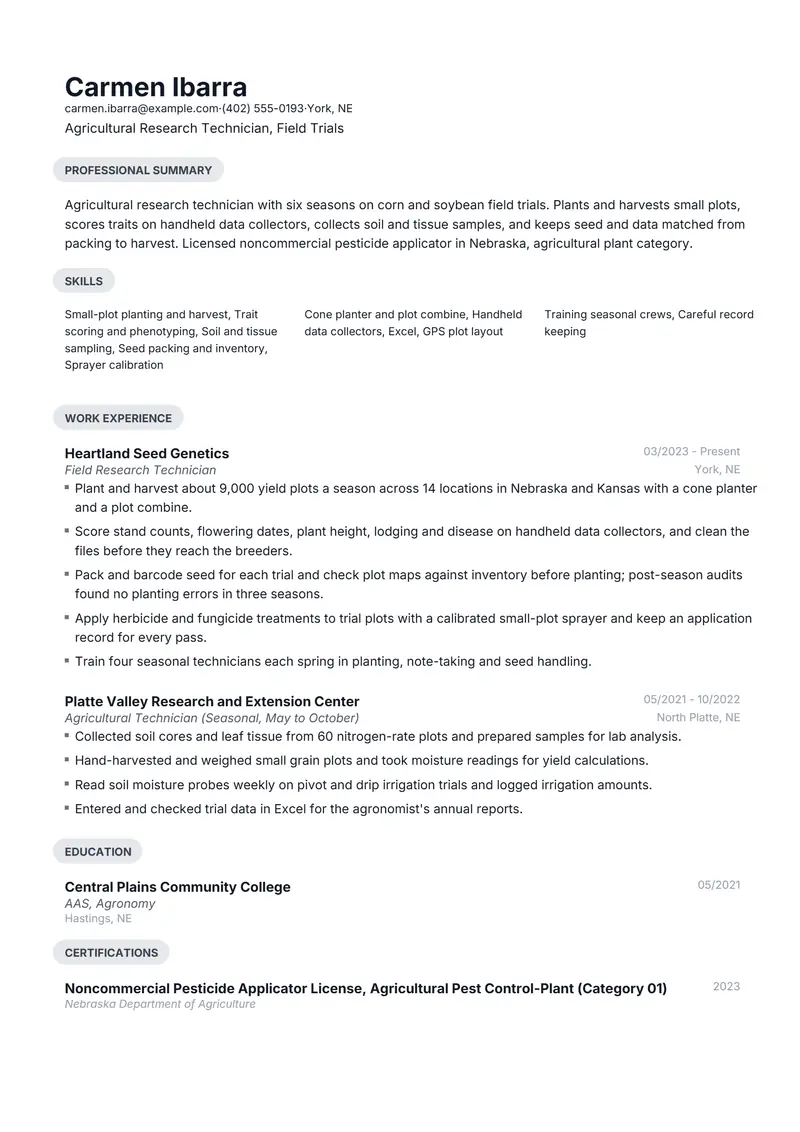
Daniel suits an agricultural technician: a short summary, then a three-column skills grid above the jobs, so a breeder or research manager sees plot, sampling and data skills at a glance. The fictional sample runs corn and soybean field trials for a seed company in Nebraska after two seasons at a university research farm, and holds a Nebraska noncommercial pesticide applicator license for crop pests.
Download the agricultural technician sample
Carmen is a fictional agricultural research technician. Replace every detail with your own before you send it.
The files are made in your browser by Resumity's own exporters, from this sample. The builder opens it as your own resume: click any line to replace it. Free plan, no watermark.
Why Daniel suits an agricultural technician resume
Daniel prints the summary and then a three-column skills grid before the job history, which fits the many short techniques a research technician is hired on: plot planting, trait scoring, soil and tissue sampling, sprayer calibration. Its rounded grey heading pills give the page a lighter look than a layout built only from rules.
Second choice: Meridian. Meridian also puts skills before the jobs but labels each row; choose it for a government research station or a lab-heavy role.
What goes in each section, in Daniel's order
Daniel prints its sections in a fixed order, the same in the PDF and the Word file. Here is that order for this sample, and what to put in each section.
- Professional Summary. Field, greenhouse or lab focus, the crops or animals, the number of seasons and the program you support (breeding, agronomy, soil fertility, pest management). Mention the applicator certification here as well.
- Skills. No group labels in the grid, so the first column should hold plot and sampling work, the second the equipment and software, the third how you work with crews and data. Keep each item to a few words.
- Work Experience. Plots planted and harvested, traits recorded, samples prepared, locations covered. Seasonal work counts: give the months and fold returning seasons with one employer into a single entry.
- Education. An associate or bachelor's degree in agronomy, plant science, animal science or a related field, with the year. A coursework line (soil science, entomology, statistics) helps while your experience is short.
- Certifications. Pesticide applicator certification with category, state and expiry, then forklift, first aid or a CDL if you drive the seed truck between locations.
The sample resume as text
The same content as the files above, so you can copy a line or compare it with your own.
Carmen Ibarra
Agricultural Research Technician, Field Trials
York, NE | carmen.ibarra@example.com | (402) 555-0193
Agricultural research technician with six seasons on corn and soybean field trials. Plants and harvests small plots, scores traits on handheld data collectors, collects soil and tissue samples, and keeps seed and data matched from packing to harvest. Licensed noncommercial pesticide applicator in Nebraska, agricultural plant category.
Experience
Field Research Technician, Heartland Seed Genetics, York, NE (03/2023 to Present)
- Plant and harvest about 9,000 yield plots a season across 14 locations in Nebraska and Kansas with a cone planter and a plot combine.
- Score stand counts, flowering dates, plant height, lodging and disease on handheld data collectors, and clean the files before they reach the breeders.
- Pack and barcode seed for each trial and check plot maps against inventory before planting; post-season audits found no planting errors in three seasons.
- Apply herbicide and fungicide treatments to trial plots with a calibrated small-plot sprayer and keep an application record for every pass.
- Train four seasonal technicians each spring in planting, note-taking and seed handling.
Agricultural Technician (Seasonal, May to October), Platte Valley Research and Extension Center, North Platte, NE (05/2021 to 10/2022)
- Collected soil cores and leaf tissue from 60 nitrogen-rate plots and prepared samples for lab analysis.
- Hand-harvested and weighed small grain plots and took moisture readings for yield calculations.
- Read soil moisture probes weekly on pivot and drip irrigation trials and logged irrigation amounts.
- Entered and checked trial data in Excel for the agronomist's annual reports.
Education
AAS, Agronomy, Central Plains Community College (05/2021). Coursework: soil science, crop production, entomology, applied statistics
Certifications
- Noncommercial Pesticide Applicator License, Agricultural Pest Control-Plant (Category 01), Nebraska Department of Agriculture (2023)
Skills
Small-plot planting and harvest, Trait scoring and phenotyping, Soil and tissue sampling, Seed packing and inventory, Sprayer calibration, Cone planter and plot combine, Handheld data collectors, Excel, GPS plot layout, Training seasonal crews, Careful record keeping
How to make the sample yours
Count plots, rows and locations
Plots per season, trial locations, samples per week. Breeding programs run at volume and want proof you keep pace without mixing up seed.
Name the traits you score
Stand counts, flowering dates, plant height, lodging, disease ratings, yield and moisture. Precise trait names show you know what the data is for.
Show care with seed and data
Plot maps checked against inventory, barcoded packets, files cleaned before they reach the breeder. One mixed-up seed lot can spoil a season of results, so research managers look hard at this.
List equipment you can run alone
Cone planters, plot combines, small-plot sprayers, soil probes, moisture meters. Mark the ones you also calibrate or service.
Adjust for livestock or lab roles
Animal research technicians list handling, feeding trials and sample collection; lab technicians list grinding, extractions and instruments. Keep the bullets that match the posting.
Keywords to keep where they are true
Terms this kind of resume is usually searched for. Use the posting's exact wording, and only for work you have done.
- agricultural technician
- field research
- plot planting
- plot harvest
- phenotyping
- trait data collection
- soil sampling
- plant tissue sampling
- seed inventory
- sprayer calibration
- greenhouse trials
- pesticide applicator
- data entry
- Excel
- GPS plot layout
Mistakes to avoid
- "Assisted with research" with no plots, traits or sample counts.
- A pesticide certification listed without its category and state.
- Dropping seasonal jobs because they were not full-time; they are often exactly the experience a trial program wants.
- A long list of lab instruments for a job spent mostly in the field.
How the sample PDF reads in text extractors
We exported this sample with Resumity's PDF exporter in Chrome on 2026-10-29 and read the file back with three open-source text extractors. This shows whether software that turns a PDF into text can recover it; it is not a test of any commercial applicant tracking system. How we test templates.
| Extractor | Name, email, phone | Headings | Bullets intact |
|---|---|---|---|
| pdf.js 4.10.38 | All found | 5 of 5 | 9 of 9 |
| pdftotext (Xpdf) 4.00 | All found | 5 of 5 | 9 of 9 |
| pypdf 6.13.0 | All found | 5 of 5 | 9 of 9 |
Frequently asked questions
Which pesticide license should an agricultural technician list?
The exact one your state issued, with its category and expiry, because the names differ from state to state. EPA splits applicators into private (applying to produce a crop on land they or their employer own or rent) and commercial, and lets states add or drop categories. Nebraska, for example, licenses noncommercial applicators who use restricted use pesticides only on land their employer owns or controls, and its licenses run for three years.
How do I list seasonal technician jobs?
One entry per employer, with the months and years and the word Seasonal in the title. Two or three returning seasons with the same program read as reliability, so keep them together rather than splitting them into separate jobs.
What is the difference between a field and a lab agricultural technician resume?
A field resume leads with plots, equipment and weather-driven scheduling; a lab resume leads with sample preparation, instruments and quality control. Many roles mix both, so order the skills grid for the one in the posting.
Should I list the crops I have worked with?
Yes, in the summary and the bullets. Corn, soybeans, wheat, sorghum and specialty crops each come with their own equipment and traits, and a hiring manager scans for their crop first.
How do I move up from technician to research associate?
Show data work beyond entry: summaries you prepared, trial layouts you helped plan, staff you trained. Add any statistics or experimental design coursework, and a bachelor's degree once you have one.
Will applicant tracking systems read this Daniel PDF?
The sample PDF read back with its contact details, all 5 section headings and all 9 bullets intact in three open-source text extractors (pdf.js, pdftotext and pypdf). Commercial systems such as Workday, Greenhouse or Taleo were not tested, and each employer configures its own.
Guides and templates for this resume
Sources, checked 29 October 2026
We opened every page below on that date. Pay, rules and requirements change, so check the source before you rely on a detail.
- U.S. Environmental Protection Agency: Federal Certification Standards for Pesticide Applicators (restricted use pesticide applicators must be certified as private or commercial; a private applicator applies pesticides to produce an agricultural commodity on land they or their employer own or rent; 10 federal commercial categories that states, territories and tribes may add to or delete from)
- Nebraska Extension Pesticide Safety Education Program: Commercial and Noncommercial Applicator Training and Certification (a noncommercial applicator applies restricted use pesticides only on lands owned or controlled by their employer or for a government agency; exams administered by the Nebraska Department of Agriculture (General Standards plus each category, such as 01 Agricultural Pest Control-Plant); licenses valid for 3 years)
More in resume templates by job title.