Resume template · Updated October 2026
Chemical industry resume template
Short answer
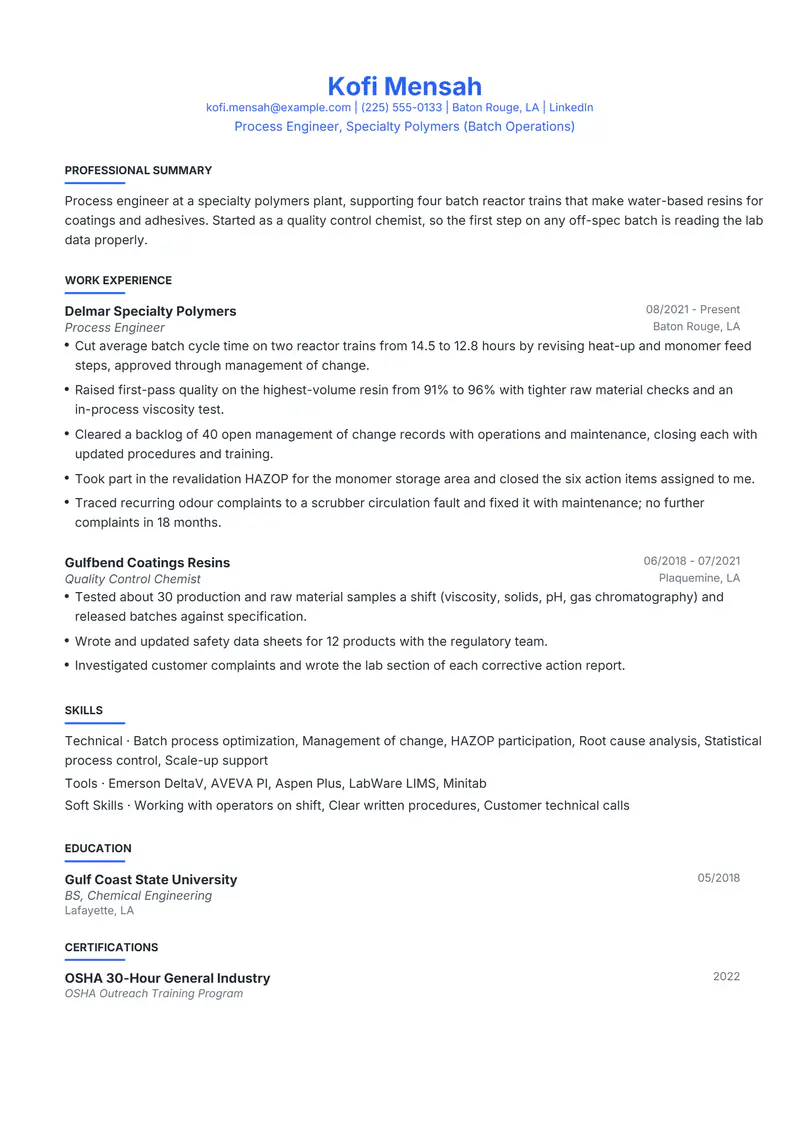
Leslie gives chemical industry resumes a clean, mostly black page with a single blue accent, and it prints work experience before skills, so yield, safety and reliability results lead. The fictional sample is a process engineer at a Baton Rouge specialty polymers plant who began as a quality control chemist, with shorter batch cycles, better first-pass quality, a cleared change backlog, HAZOP actions and an odour complaint fixed.
Download the chemical industry sample
Kofi is a fictional process engineer. Replace every detail with your own before you send it.
The files are made in your browser by Resumity's own exporters, from this sample. The builder opens it as your own resume: click any line to replace it. Free plan, no watermark.
Why Leslie suits a chemical industry resume
Leslie prints work experience directly under the summary, ahead of the skills rows, and in chemical plants what you changed on a unit (yield, cycle time, incidents, emissions) says more than a software list. The centred blue name gives the page one quiet accent without pulling a plant manager's eye from the numbers.
Second choice: Henrietta. Henrietta is all black and grey and prints education right after the jobs, useful for chemists and R&D roles where degree level sets the grade.
What goes in each section, in Leslie's order
Leslie prints its sections in a fixed order, the same in the PDF and the Word file. Here is that order for this sample, and what to put in each section.
- Professional Summary. Chemicals is a wide field: commodity and petrochemicals, specialty and performance chemicals, coatings, agricultural chemicals, consumer products and distribution. Name the chemistry and the process type (batch or continuous), then your function: operations, process engineering, lab, EHS, supply chain or technical sales.
- Work Experience. Plants judge people on safe, steady production. Use yield, cycle time, first-pass quality, unplanned downtime, energy or raw material use, recordable incidents and environmental exceedances, and mention the hazard review or change process behind each improvement. Chemical employers want changes made safely, not just quickly.
- Skills. Leslie prints labelled rows after the jobs. Technical takes process and safety methods (HAZOP participation, management of change, root cause analysis, statistical process control); Tools takes the control system, data historian, process simulator and LIMS.
- Education. Chemical engineering or chemistry for engineers and chemists; a process technology associate degree for operators. Add a plant co-op if you graduated in the last few years.
- Certifications. Safety training cards, belt certifications and any engineering licence, each with the issuer and year. Operators often add hazardous materials or confined space training; drop anything that has lapsed.
The sample resume as text
The same content as the files above, so you can copy a line or compare it with your own.
Kofi Mensah
Process Engineer, Specialty Polymers (Batch Operations)
Baton Rouge, LA | kofi.mensah@example.com | (225) 555-0133 | linkedin.com/in/sample-kofi-mensah
Process engineer at a specialty polymers plant, supporting four batch reactor trains that make water-based resins for coatings and adhesives. Started as a quality control chemist, so the first step on any off-spec batch is reading the lab data properly.
Experience
Process Engineer, Delmar Specialty Polymers, Baton Rouge, LA (08/2021 to Present)
- Cut average batch cycle time on two reactor trains from 14.5 to 12.8 hours by revising heat-up and monomer feed steps, approved through management of change.
- Raised first-pass quality on the highest-volume resin from 91% to 96% with tighter raw material checks and an in-process viscosity test.
- Cleared a backlog of 40 open management of change records with operations and maintenance, closing each with updated procedures and training.
- Took part in the revalidation HAZOP for the monomer storage area and closed the six action items assigned to me.
- Traced recurring odour complaints to a scrubber circulation fault and fixed it with maintenance; no further complaints in 18 months.
Quality Control Chemist, Gulfbend Coatings Resins, Plaquemine, LA (06/2018 to 07/2021)
- Tested about 30 production and raw material samples a shift (viscosity, solids, pH, gas chromatography) and released batches against specification.
- Wrote and updated safety data sheets for 12 products with the regulatory team.
- Investigated customer complaints and wrote the lab section of each corrective action report.
Education
BS, Chemical Engineering, Gulf Coast State University (05/2018)
Certifications
- OSHA 30-Hour General Industry, OSHA Outreach Training Program (2022)
Skills
Batch process optimization, Management of change, HAZOP participation, Root cause analysis, Statistical process control, Scale-up support, Emerson DeltaV, AVEVA PI, Aspen Plus, LabWare LIMS, Minitab, Working with operators on shift, Clear written procedures, Customer technical calls
How to make the sample yours
Show hazard communication know-how
OSHA's Hazard Communication Standard (29 CFR 1910.1200) is written to be consistent with the UN Globally Harmonized System and requires safety data sheets with 16 sections in a set order. Lab and EHS staff who author or review SDSs and labels can say so plainly.
Name the risk programme your unit is under
EPA's Risk Management Program (40 CFR Part 68) applies to stationary sources holding more than a threshold quantity of a regulated substance in a process; a process that does not qualify for Program 1 and is also under OSHA's process safety standard falls in Program 3. If your unit is covered, mention the hazard reviews, drills or audits you joined.
Mention Responsible Care where it applies
All American Chemistry Council members implement Responsible Care, the industry's environmental, health, safety and security initiative. If your site reports under it, a line on the measures you owned fits naturally.
From lab to plant, or plant to lab
Chemists moving into process roles should stress scale-up, off-spec troubleshooting and work alongside operators. Process people moving into R&D should stress experiments designed and data analysed.
Operators and technicians
Board operators and field technicians can keep this layout, swapping engineering projects for units run, procedures written, nuisance alarms removed and years without a recordable. Put the process type in the headline.
Keywords to keep where they are true
Terms this kind of resume is usually searched for. Use the posting's exact wording, and only for work you have done.
- chemical manufacturing
- process engineering
- batch processing
- process safety
- management of change (MOC)
- HAZOP
- root cause analysis
- yield improvement
- distributed control system (DCS)
- hazard communication
- safety data sheets
- environmental compliance
- scale-up
- statistical process control
- Responsible Care
Mistakes to avoid
- A safety or environmental record claimed for the whole site when your scope was one unit.
- Recipes, operating conditions or customer formulations that are trade secrets.
- HAZOP or MOC listed as skills with no word on the part you played in either.
- An objective about "a challenging role in a dynamic company" where the chemistry and processes you know should be.
How the sample PDF reads in text extractors
We exported this sample with Resumity's PDF exporter in Chrome on 2026-10-29 and read the file back with three open-source text extractors. This shows whether software that turns a PDF into text can recover it; it is not a test of any commercial applicant tracking system. How we test templates.
| Extractor | Name, email, phone | Headings | Bullets intact |
|---|---|---|---|
| pdf.js 4.10.38 | All found | 5 of 5 | 8 of 8 |
| pdftotext (Xpdf) 4.00 | All found | 5 of 5 | 8 of 8 |
| pypdf 6.13.0 | All found | 5 of 5 | 8 of 8 |
Frequently asked questions
How do I get into the chemical industry with a chemistry degree?
Quality control, R&D technician and process chemist roles are common first steps. Show the lab methods you have used, safety training, data handling and any internship or research with a production or scale-up angle.
Should operators list the units and equipment they run?
Yes: the process (reactors, distillation, dryers, packaging), the control system and the shift pattern. Plants value people who already know similar equipment because training takes a long time.
How do I show safety without sounding generic?
Give one concrete example: a near miss you reported that led to a fix, a hazard review action you closed, a procedure you rewrote. Add your incident record if it is good and you can stand behind it.
Can I move from chemicals into pharma or food?
Yes. Batch processing, quality systems and validation carry over. Learn the GMP vocabulary those industries use and show the documentation discipline you already practise.
How technical should a chemical industry resume be?
Technical enough that another engineer could picture the work: the process step, the equipment and the variable you changed. Keep proprietary recipes and conditions out.
Will applicant tracking systems read this Leslie PDF?
The sample PDF read back with its contact details, all 5 section headings and all 8 bullets intact in three open-source text extractors (pdf.js, pdftotext and pypdf). Commercial systems such as Workday, Greenhouse or Taleo were not tested, and each employer configures its own.
Guides and templates for this resume
Sources, checked 29 October 2026
We opened every page below on that date. Pay, rules and requirements change, so check the source before you rely on a detail.
- Legal Information Institute, Cornell Law School: 29 CFR 1910.1200 Hazard communication (intended to be consistent with the UN Globally Harmonized System (primarily Revision 7); safety data sheets must contain 16 sections in a specified order; employee information and training required)
- Legal Information Institute, Cornell Law School: 40 CFR 68.10 Applicability (applies to an owner or operator of a stationary source with more than a threshold quantity of a regulated substance in a process; Program 3 covers processes not eligible for Program 1 that are in listed NAICS codes or subject to 29 CFR 1910.119)
- American Chemistry Council: Information about Responsible Care (the chemical industry's environmental, health, safety and security performance initiative; as a component of membership, all ACC members implement Responsible Care)
More in resume templates by industry.